
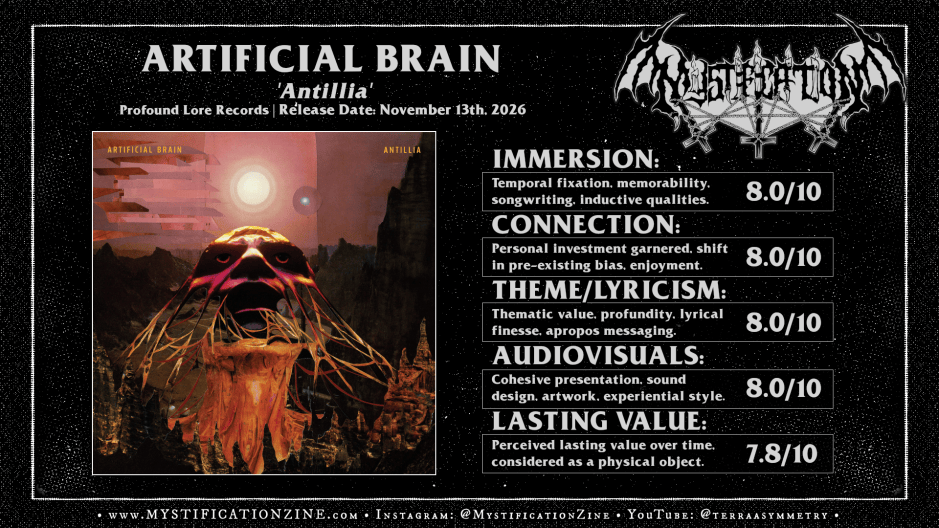
Mutated, assailed and transformed down to their very DNA from all potential angles of invasion the desecration of humanity depicted within this fourth full-length album from Richmond, Virginia-based death metal quintet ARTIFICIAL BRAIN reads as ruthless as it does surreal in action. A set of nine future-now science fictive horror vignettes set right to the edge of avant-garde/progressive death temperament ‘Antillia‘ recombines and restates the blackened technical death metal band’s long-running directive. Evoking a realm in disarray while taking emboldened steps outside of their well-established cadre the revamped troupe’s work here may breathe a bit of chaos throughout but the combination of well-polished sound design and erratic craft is resplendent in effect once fully digested.
Artificial Brain formed back in 2011 as a quintet ensemble between folks known for their hand(s) in Revocation, Grey Skies Fallen, and Biolich among (many) others as they’d collectively aimed for a modern form of technical death metal marked by dissonant, blackened and progressive metal abandon. Rather than dig through their discography a second time I’d point listeners to a demo collection available online which best illustrates the level of skill, preparedness and conceptual torsion applied to their starting point as many of those ideas continue to echo through their work today. Otherwise I’d point to the band’s third album (‘Artificial Brain‘, 2022) as a watershed moment, a heightened state of collaboration which’d best realized their core ideal in estranged progressive sprawl. From that point their alignment fractured per a seeming mixture of practical and artistic concerns as three of their (then) six members would exit, leaving behind the distinct vocals of Will Smith (Afterbirth) alongside two other founding-era members in the years between.
Something is lost, something is gained. — While it seems the core mechanical authorship of Artificial Brain is intact no doubt the addition of Mike Paparo (Inter Arma), who’d provided vocals for guitarist Dan Gargiulo‘s pandemic death metal project Dreamless Veil a few years back, brings a decidedly different tonal range here which pulls away from the atmospheric bellows provided by Smith‘s unique style. Paparo‘s knack for complex diction showcases throughout the full listen and his work is a strong feature here but don’t confuse him with several guest spots from Doug Moore (Pyrrhon), Andrea Collaro (Devoid of Thought) and the band’s live vocalist Paulo Paguntalan (Miasmatic Necrosis, ex-Copremesis) along the way. These insertions are testament to both big shoes to fill and the more aggressive, compact and detailed push which ‘Antillia‘ proposes, a set of changes which aren’t necessarily as dramatic as they appear on paper.
A surrealistic melancholia persists as the driving weight atop ‘Antillia‘ as its depictions of a disintegrating humanity under constant subversion find Artificial Brain flitting between angst, vexation and heady bouts of dissociation. In this sense the greater tonal shift and glossier ebony sheen of the album’s production values (via engineering/mixing from Ian Jacyszyn and mastering from Colin Marston) might sit crookedly with folks expecting the odd warmth and patience of ‘Artificial Brain‘ but they suit the task at hand where we find new lyrical perspectives and a rejiggering of the band’s stylistic parameters. This time around each song is its own scene, not necessarily a new subject every piece but the running order emphasizes ouevre over pour-ready flow by my measure.
A shriek of guitar feedback and a maniac swipe into Immolation-esque trudge introduces the sauntering hand of opener “The Wandering Star Prion”, a piece which hits with such immediacy its rhythms are forced to detangle and strike dissonant refrain to stave too-hurried flow. Lava-spitting solos begin to fly and the pace stalls but Artificial Brain‘s temperament reveals itself a snarling, nightcrawling beast outright. As ‘Antillia‘ kicks off with its opening series of shorter pieces, which are high on detail but less prone to repetitious recall, the listener’s first pass is energetic in its chaotic spiral in and out of phase but the band’s signature is set aloud via standout piece “Quantum Malignancies” thanks to gutturals provided by Paguntalan to start. The path through those first few songs appear to reflect a loss of place, or, safety amidst an nanotech-spawned invasion which quickly proves too efficient to deny.
That opening salvo is a thrill, a chunk of detail that the note-needlers and tech fingered folks out there should appreciate in its heady concoct but I’d found ‘Antillia‘ splays considerably as it plays, displaying notable black metal and progressive metal nods as its mid-point dodges toward Side B. “Against the Furthest Reaches of the Light” opens the door in this respect, at least in the most obviate sense, almost hitting like earlier 2000’s Enslaved on the jog through, but I’d point to the proggy post-black melodrama of “Solar Ark” as the real push out to drift here. They’ve not betrayed the Artificial Brain way to be sure but if you’d gone into this record expecting dense technical death metal with a few washes of black metallic moodiness the second half of the album may surprise with its willingness to escape that framing well beyond a tangent here and there. If anything I’d wanted more blackened dissonance and post-black whorl (re: Suffering Hour-esque “Antillia (In Chromatic Aberration)”) once familiar with the whole deal.
From prog rock/kraut oddities to the subversive nostalgia of Winston Smith collage art has a grand tradition in most all musical spaces but we don’t get a ton of it in extreme metal beyond the punk-derived traditions of grindcore and perhaps the odd third-gen deathgrind record. As glitched and bizarre as the cover art from Fleshflies might appear in a certain context it instantly distinguishes ‘Antillia‘ as an odd duck, an outlier suitable per the myriad nature of Artificial Brain‘s work at this point of new-found identity. The total audio-visual effect of the release is fittingly surreal, a judicious artistic remapping which retains the band’s general identity while pursuing alternate paths away from the usual generica-prone tech/prog death authorship. Though some fans might miss some of the idiosyncratic performances of the band’s past, or may not gel with some of the black metal focus here and there, this new material manages to meet their ‘ready established high standards nonetheless. A high recommendation.


Help Support Mystification Zine’s goals with a donation:
Please consider donating directly to site costs and project funding using PayPal.
$1.00
Make a one-time donation
Make a monthly donation
Make a yearly donation
Choose an amount
Or enter a custom amount
Your contribution is appreciated.
Your contribution is appreciated.
Your contribution is appreciated.

