
• MASSIVE REVIEWING CAPACITY • is our latest short review column focusing on stray quality releases a few times a month, or, roughly every two weeks depending on the current month’s release schedule. In an attempt to be more conversational these are easygoing and casual thoughts for the most part, so relax and think for yourself as I attempt to find something, anything to say about multitudes of new releases relevant to my interests. — If you find a record you dig go tell the band on social media and support them with a purchase. If you’d like your music reviewed, read the FAQ and send promos to: grizzlybutts@hotmail.com
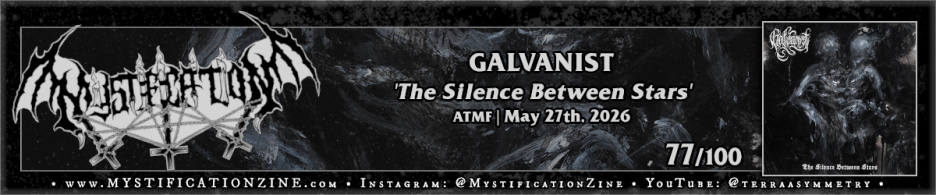
This second full-length album from Bozeman, Montana-based quartet GALVANIST continues to explore imaginative atmospheric space upheld between post-black metal, extreme doom and post-metal. ‘The Silence Between Stars‘ once again leans into longer-form pieces (~8-10 minute avg.) but their works are yet shorter and more numerous this time around to disperse their glom of celestially sparked atmospheric metal further. Psychic intuition suggests there is possibly a bit of a ‘Times of Grace‘-level (alt. ‘Salvation‘) brain working some of these rhythms but the majority of the pieces here offer bleakly distant, almost resigned depressive ponder sprawling in psychedelic waves, all of it sternly introspective in tone. Sound design is appropriately massive despite a too-glossy rhythm section capture and they’ve done well to contain the harder punched pieces (“Spiorad”) in the same realm as the inner-delving stuff which dominates. I’d particularly enjoyed the dynamic shared between “Dreich” and “Hauntology”, their paired effect reads as bouts of both solemnity and wonderment with marked proclivity for the former. I’d recommend some patience for this one, not only does the sub-genre fusion at hand call for it by phenotype but the final three pieces are detailed and dramatic enough to let breathe in mind.
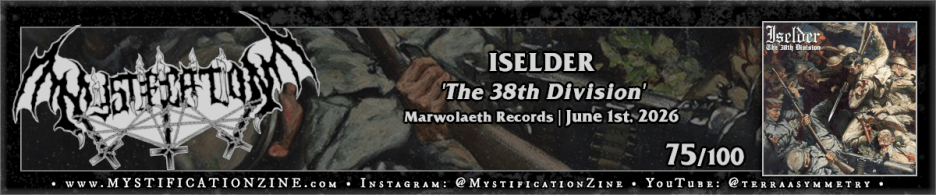
Without any imagined space to move beyond noxious barked vocals, nakedly programmed drums and blunt-edged semi-melodic riffs a fair deal of the actual movement on ISELDER‘s fifth full-length album, ‘The 30th Division‘, falls into a curiously hardcorish, almost death metal informed space. That isn’t a huge complaint, though, as their trample through early-set piece “Call to Arms” (and “Impending War”, “Embrace the End” after) may be cold and flat in delivery there is yet some vague analogue for Grand Belial’s Key or even Inquisition occurring therein, intentional or otherwise. Some of their simpler, repetitious grooves feel unfinished in thought yet achieve a reasonably read voice overall, given to the occasional Mardukian throttle and/or heavy metal shape. This works best when their mechanical performance stabs at full throttle, their mid-paced material (re: “Llywelyn the Last”) hits like an open-air moshpit otherwise. Vocals need more variety (or distance, reverb) and the album lacks a proper bass guitar tone but it’d pulled me back in for a number of listens by its own merits.
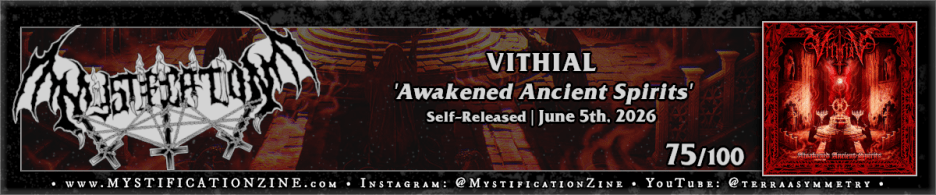
There is a hissing powerlessness exuded by the vocal performances on this debut full-length album from Pensacola, Florida-based melodic black/death metal project VITHIAL, a vacuous black-winged snarl tucked up in the rafters and cursing in coldly dramatic recitation. It bugged the shit out of me to start but only until the resplendent melodrama of “Masquerading Deception of Tyranny” where this student of second wave melodic black metal should be recognized. Compositions here are sometimes more rooted in earlier Emperor type expression and less the tunneling wrath of the earlier 90’s Swedish sect but I’m primarily disappointed that these six songs do not even slightly deliver on the suggestion of Florida death metal inspiration. Though the pacing of ‘Awakened Ancient Spirits‘ feels glacial in the midst the meticulous level of detail applied to each piece is admirable, especially title track/closer “Awakened Ancient Spirits” and the similarly keyboard-tipped “War of the Gods, the Balance of Darkness and Light”.
Paderborn, Germany-based pagan black metal duo HORN‘s work continues to reach for new sounds, varied vocal performances and folken interest on this eleventh full-length album. On paper the credits and description of ‘Apocalyps 1618‘ reads as if it’ll be a bells-and-whistles sort of affair but a dire and driven tone overrules the experimentation, multiple languages deployed and guest spots which dot their landscape making for an entirely consistent narrative read. This ends up being less accessible than some of the choices made on ‘Daudswiärk‘ (2024) and ‘Mohngang‘ (2020) with fewer punkish, catchier rallies and more of a solemn, sometimes ‘epic’ fortitude threaded through each piece. The experiment found on “Barhout” is a strong album highlight and their interpretation of “At Our Bleakest”, which I believe is a song from Nerrath‘s doom metal band Cross Vault, is extremely well done but the majority of the album carries a striding melodicism which becomes a dominant aspect of their evolving signature with each release. The quality and consistency of their work this last decade is commendable and the more downtrodden and dramatic the mood the better. Favorite piece here is probably “Die Ahren gleich als mit dem Huf” but I’d enjoyed the main progression behind “Am Abgrund steht der Junker” and the gloom of “Hiofan Mahnt” before it just as well.
This split LP between Trondheim, Norway-based solo project ENEVELDE and trio GJENDØD won’t likely shock the Nidrosian forum with its style or sound, each band is well established as part(s) of even more expansive prolific agenda on both sides and the material here is uniformly inspired and well-traditioned. For my own taste B. Kråbøl‘s general output is above average and his work as Enevelde on Side A of ‘Elegier fra avgrunnen‘ is no exception. When constrained by ~3-5 minute black metal songs the artist leans into textural interest and slow-arcing grooves for impact, I particularly enjoyed the basslines worming through “Langt fra umaken verdt” in this sense. The ranting of “På dødelige terskler” is inspired and the more atmospheric frothing of “Fødselsdefekt” entertains just as well but I’m not sure thier side of the split reads as more than extra bits beyond ‘Pandemonium‘ (2024). Gjendød are likewise up to their usual misdeeds and malice via a comparatively harsh register b/w a similarly adventurous rhythm section prone to wander and linger in its floating phrases (“Dødsrikets pinsler”). I particularly enjoyed the waltzing estrangement of “Mennesketårnet faller” ands its Taake-esque swinging interruption and how it’d felt threaded right into the nauseous verve of closer “Utslettelsen”. The pairing makes sense well enough though, especially for fans of either/both band looking to hoard their output at a point of prime momentum.
Dortmund, Germany-based black metal trio GRABUNHOLD now reach their tenth year in action with this sophomore full-length, ‘Frostheim‘, where their work is yet dedicated to a melodic second wave inspired sounds. With admirable focus upon Tolkien-writ realms and the great battles fought within this second album simply expands the rhythmic vernacular established on their debut (‘Heldentod‘, 2021) some years ago while enriching the atmospheric depth of their render. The overall template and impact of this second LP is very similar to the first and as such it should please the skulls of folks who’d fawned over their debut. Though I’m not sure it curb-stomps the cleverness of bands like Mavorim out of mind entirely just yet but the pagan metal feeling of thier work only intensifies here and to great effect. First half is all great, second half is nearly as good but the riff ideas appear to drain as it plays.
“Are they doom metal yet?” The precipice occupied by talented Sundsvall, Sweden-based heavy rock quartet TIDAL WAVE continues to vex my senses with their grungy, stoney, Sabbath-groovin’ third full-length album. Much of my observations here align with what I’d written about their previous LP yet ‘Volume Tree‘ manages even more compelling argument for their station to start as Side A is encouraging per it’s 90’s cum 70’s songcraft and soaring vocalist. The aesthetic here is hideous for my own tastes, the whole deal is super glossed to the point that it feels disconnected from the soil of heavy blues, yet this one pierced into a part of my brain active since the early 90’s for a solid moment. Then the song “Sideburns” hits over on Side B and for whatever reason the “fun” of the moment had me fully nonplussed, totally stopped caring. Consider that more of a criticism of my own sensibilities than the band’s work, of course.
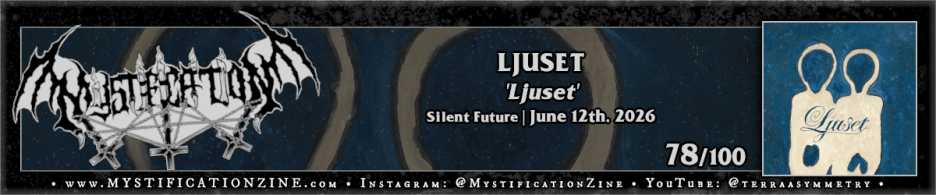
Without pecking back in time and doing any diligence beyond recognizing Simon Johansson of Bhleg in their ranks I’d taken to this debut full-length album from reconnected Swedish depressive rock/post-black duo LJUSET as anxious fowl to black water. Without any real love for either suggested sub-genre these days I’d nonetheless enjoyed the terminally introspective function of their sometimes black metallic work and its wilted strand of bass-walked pieces. ‘Ljuset‘ more-or-less approximates the impact of “dark metal” on relatively modern terms by way of interest in indie rock and post-punk sans the too-obvious gothic rock/guitar heroic references of the mid-90’s. If you are a similarly simple creature enticed by droning basslines and chiming guitars it’ll like carry some water with you (re: “Draken”) but I’d recommend a full listen rather than picking and choosing amongst the order as the sinking feeling emitted by ‘Ljuset‘ makes the most sense within the procession ‘ready outlined. If you’re more concerned with black metal applications you won’t find any one track that represents this side of their work best as most of this inspiration amounts to fits of scribbling atmospheric/post-black interruptus. “Hämnden” is maybe the meanest of the lot in that regard. “Nyckeln” offers the clearest juxtaposition inherent to this work but “Vännen” is the one that’d stuck with me longest, potentially the most representative piece on the full listen. I’d found this record well contained in its greater arcing thought and a clear bolt of inspiration elaborated to a possibly too-fine point of detail.
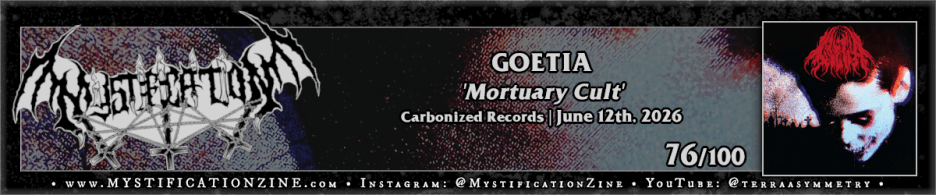
Snarling and crashing all around Washington, D.C.-based death metal trio GOETIA emerge abreast the momentum of three well-received EP releases with a grinding n’ thrashing debut full-length album in ‘Mortuary Cult‘. Featuring folks from defunct death metal band Perpetuated, a former Genocide Pact guitarist, and the drummer who’d played on the most recent Blood Monolith record no doubt these folks bring a certain level of experience to their craft… though I’d been hung up on the sub-genre tag to start. Vocalist/bassist Matt Stock‘s performances are shrill, puked a la a USBM or black/thrash apropos yowl and most of the pieces on this album amount to stomped-up hardcore inspired deathgrind (“Corpse Candle”) and this pulls me away from the unqualified straight death metal description, particularly on Side A. I’m not saying this record is friggin’ ‘Terrifyer‘ or whatever, “Earth Inferno” challenges that sensibility well enough, but a big part of their glom appears rooted in a certain era of grindcore as their treatment of death/thrash, crusty death metal and such all reads secondary on approach. Otherwise the chaotic freakout at hand is yet entertaining, particularly the more maniac cuts like “Bestial Tomb”, “Eternal Samhain” and “Posthumous Execution”.
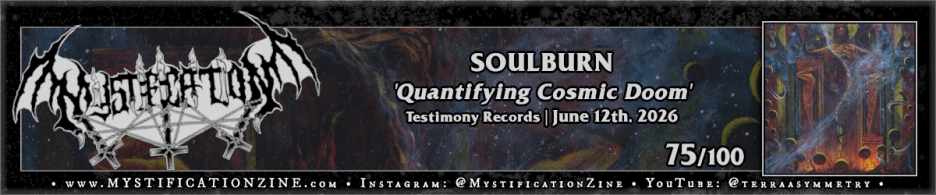
No doubt for the average Asphyx fan the name SOULBURN is an interesting side note for the classic Dutch death metal band’s least popular era that’d followed the weaker ‘God Cries‘ (1996) and the venerable archival release ‘Embrace the Death‘ (1996). After Theo Loomans (R.I.P.) left the band they’d split and a couple members brought in Wannes Gubbels of Pentacle not only for ‘Feeding on Angels‘ (1998) but also the subsequent return of Asphyx (with the same sound and line-up) for the also not-so well marketed or remembered ‘On the Wings of Inferno‘ (2000). I detail all of this ~history for the sake of providing context per their longtime fandom, suggesting how brutally unrelated the revival of the Soulburn name has appeared to its inception since 2014, yielding four black, death and doom informed records.
Some folks who’d followed me back in the early 2010’s might recall I was once prone to talk up ‘Feeding on Angels‘, citing it as an underrated entry in the Asphyx lore but I’d shut up about it when black metal focused ‘The Suffocating Darkness‘ (2014) dropped. That new black/death/doom centered line-up just never picked the riffs back up for my taste as they’d soon whittled down the line-up to feature members of Graceless as well as Sauron guitarist Twan van Geel on vocals. Those three albums were bland but not bad, unable to find a balance between the raw simplicity of ‘old school’ stuff with modern, often unrelated interests. Six years beyond their largely ignored 2020 LP Soulburn return with ‘Quantifying Cosmic Doom‘, a work which is no less cross-wired but generally persists with greater ambition.
Questionable clean vocals, experimental layering throughout, and a few reused rhythmic shapes reconstitute Soulburn without a clear throughway for their identity. Some of this album reads as jaunty black n’ roll with an atmospheric black ebb, other pieces land like strobe light worthy danceable death metal disco yet none of it seems to aim for accessibility so much as a curious gothic doom analogue. All of this is fine enough, certainly not a revelation for my own taste but creative in its odd strokes (“Down Among the Stars” stoner death/doom?), but I suppose the more pressing question is: Who is this album ultimately for beyond my own ‘old school’ tied interest? I suppose if you’re a fan of the landscape ‘Monotheist‘-era Celtic Frost revealed you will be at home here, though I’m not sure the clean vocals are quality enough to pull it off.

<strong>Help Support Grizzly Butts’ goals with a donation:</strong>
Please consider donating directly to site costs and project funding using PayPal.
$1.00
Make a one-time donation
Make a monthly donation
Make a yearly donation
Choose an amount
Or enter a custom amount
Your contribution is appreciated.
Your contribution is appreciated.
Your contribution is appreciated.

