

A decade beyond their emergence from an overgrown and long-forgotten graveyard Sala, Sweden-borne death metal quintet WOMBBATH have begun peering deeper, bravely into the portals beyond with each release. Now arriving upon album number seven having achieved their most focused and distinct recording in some years they’ve found some appreciable distinction which exceeds the usual trappings of early populist Swedish death metal movements. Smartly centering their craft around their members’ strengths and honing eerie atmospheric dread, symphonic accoutrement, and a shock of doom from them ‘Beyond the Abyss‘ is nigh eclectic per the band’s usual standards as they condense the bevvy of ideas found on their previous record into one fascinating enough pillar of dread-filled, grimy ‘old school’ inspired yet not so ancient-minded death metal.
Wombbath officially formed circa 1990 after having dicked around with covers (as The Shadow) before changing their name to Siezure and pulling in two more members. The reality of idolizing lost gems, nostalgic times and whatnot is that we often lose sight of the actual context, or, impact of an artist in their own time so it is worth mentioning that these folks were pretty damn young and probably the only decent band out of the Sala area (check out the somewhat related Disgrace tape ‘The Last Sign of Existence‘, and Tragic Serenade‘s tapes were alright too) who could more-or-less write a decent death metal song. For many their first demo tape (‘Brutal Mights‘, 1992) and the 7″ that followed (‘Several Shapes‘, 1992) stand out today as something not so typically aligned with the popular sound of Scandinavian death metal at the time, at least in the sense that they didn’t sound like Dismember or Entombed outright. Despite having been in the right place at just about the right time their debut LP (‘Internal Caustic Torments‘, 1993) met the same fate as many of the infamous Thrash Records/Infest Records stable (Megaslaughter, Epitaph, Excruciate, etc.) in that it was largely ignored, viewed as “slow” and generic by most lasting accounts. It is an interesting spin to return to for its mid-paced, chunking riffs and deeper vocals though they’d never quite struck upon the profundity of say, Gorement or God Macabre for my own taste.
The nail in the coffin for the 1990-1995 run of the band was ‘Lavatory‘ (1994) a unique death n’ roll/gothic death metal EP that’d been their quick “in” for Napalm Records… who didn’t even bother to acknowledge the discarded album the band demoed for the label before splitting. Rumors of how bad that EP sucks are exaggerated by death n’ roll standards, the worst parts are just weird prog-death Faith No More goofin’ shit which is nowhere near as bad as say, Electrocution‘s (Italy) funk metal EP or whatever. The ex-death metal kid sellout garbage fire was burning so high worldwide at that point it’d simply gone unnoticed alongside Wombbath‘s prior gear. At that point guitarist Håkan Stuvemark formed melodic death metal band In Thy Dreams alongside folks would would go on to form Armageddon and Carnal Forge, they were (once again) largely viewed as generic though I’d recommend taking a detour to their first EP (‘Stream of Dispraised Souls‘, 1997) if you’re big on the No Fashion adjacent melodic death metal of the time. I find all of their stuff very good listening; The point(s) to be made here is that [1] There is some cool ‘old school’ Swedish death metal linked to this name. Weird kids making brutal, eerie death metal music. [2] Very little of this obscure history has factored into the revival of the band from Stuvemark beyond 2014 beyond some re-recordings via ‘Tales of Madness‘ (2020).
Wombbath have released six albums in the last ten years and the biggest hype came with their return with a sophomore LP (‘Downfall Rising‘, 2015) sporting a Boss HM-2 busted sound which had little to do with their original gig and brough in some folks from The Absence and now longtime collaborator Jonny Pettersson (Just Before Dawn, Human Harvest, et al.) consider it less of a “comeback” and more of a generalist hit of Swedish death metal nostalgia. From that point they’ve tempered the guitar tone, incorporated more melody into their work and done everything they can to work up some atmospheric interest from album to album, none of them major standouts for my own taste. The most recent record from the band (‘Agma‘, 2021) was a whopping ~72 minutes long and attempted to expand their ouevre, reaching into a glut of generica and pulling in some blackened death elements amidst keys and all manner of “whatever sticks” at that point. I’d no real reason or interest in checking out ‘Beyond the Abyss‘ based on what a mile high stacked nothing-burger the previous album had been. So, I’ll get it if you’re not up for another Swedeath buzzer from a zombified brand resurrection with creative diarrhea in mouth but after spending a couple months with this record I have to admit it kinda rules.
Rather than suggest a full paradigm shift in terms of songcraft or evolutionary traits carrying on I’d say quality over quantity is the major shift from ‘Agma‘ ’til today, at least in the sense that ‘Beyond the Abyss‘ takes those experimental nodes spread across the previous LP and uses them as prompts for most all of its nine core pieces and expands upon them while keeping it doubly succinct, clocking in under ~43 minutes. The lead single/title track (“Beyond the Abyss“) hinted at some of this, taking a few of the tricks they’ve been toying with for a while (such as the use of violins to mimic a riff progression, see also: “Symphony of Dread”) and set it next to good old Swedeath trample which to me has a punkish but also kinda early Hypocrisy feeling to it thanks to a not-so HM-2 bombed guitar tone. Opener “Words Unspoken” has a sort of melodeath (the Dismember way) tinge to its trade between groove heavy kicks and chorale-boosted lead sections, piquing my interest with its tremolo picked dagger of a main verse riff, some ‘Necroticism‘-esque bent to the rhythms… and we find a more immediate and deliberate Wombbath surfaces when their ideas are honed down to their biggest impact.
Instead of getting just another Swedish death metal chunk and roar chipping through a few cool ideas each of the songs on ‘Beyond the Abyss‘ reaches for an idea, some manner of differentiation between its pieces. Some of these ideas are stronger than others, such as the almost self-descriptive “Discord of Doom” where they’ve married some dissonantly rung riffs into a bleakly melodic roll of a song and a guitar sound I’d particularly enjoyed. I don’t know if I’d necessarily compare that moment and its surrounding burst of ideas as Edge of Sanity-esque, even their second album was more adventurous in some respect, but I do appreciate that Wombbath sound inspired on this record, or, at least ready to reach for different ideas, eerie and ugly sounds (“Malevolent”) where I feel like we get more impact from both vocalist/guitarist Pettersson‘s compositional hand expanding and utilizing the broad skill set from guitarist/violinist Thomas von Wachenfeldt (Wachenfeldt) beyond the few more challenging pieces found in the bloat of ‘Agma‘.
Not every song hits, though, as the sleepier crunch through “Faces of Tragedy” and the slightly grating peak/endpoint of “Consumed by Fire” are just along for the ride when sidled next to either too similar or more immediately compelling songs. “Deep Hunger” is probably the most ear-grabbing piece on Side B most of which lean into the “symphonic” or keys/violin juiced movements (not exactly ‘Symphony Masses – Ho Draken Ho Megas‘ but you get the idea) and overall I’d found this was a strong point of unification for the album/listening experience as a whole which is surprisingly coherent despite having three songwriters sharing the duties.
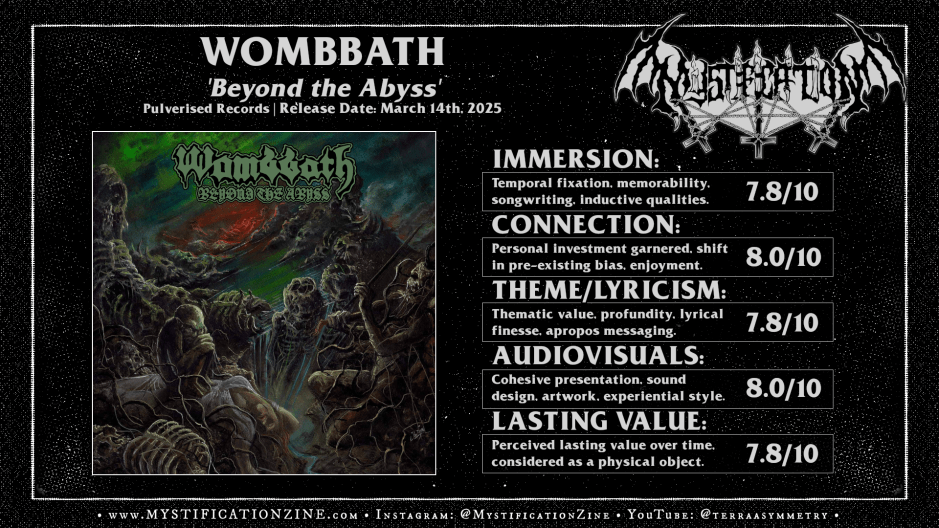
While I don’t know if I’m ready to call myself the biggest knock-down, squealing and spitting Wombbath fan just yet I’ll admit that where they’ve arrived after ten years of work is far more interesting than where their second life began. The filthier, darker atmospheric vision upheld within ‘Beyond the Abyss‘ feels like it addresses the need for both variety and consistency in an appealing way while providing some of their most doomed and melodic peaks to date. Otherwise they’ve always done well to curate their records with decent cover art and the grotesque image from Julian Felipe Mora Ibañez (re: the most recent Consumption album) impresses for its rotten color palette, odd horizon line and Fuseli-referenced incubus as an appropriately busied and death metal apropos image. If the goal was to keep one foot in their rooted past and one hand pointing toward current standards they’ve done a fine job of focusing on their best attributes within album number seven. A moderately high recommendation.


Help Support Grizzly Butts’ goals with a donation:
Please consider donating directly to site costs and project funding using PayPal.
$1.00
Make a one-time donation
Make a monthly donation
Make a yearly donation
Choose an amount
Or enter a custom amount
Your contribution is appreciated.
Your contribution is appreciated.
Your contribution is appreciated.
DonateDonate monthlyDonate yearly mystificationzine.com