
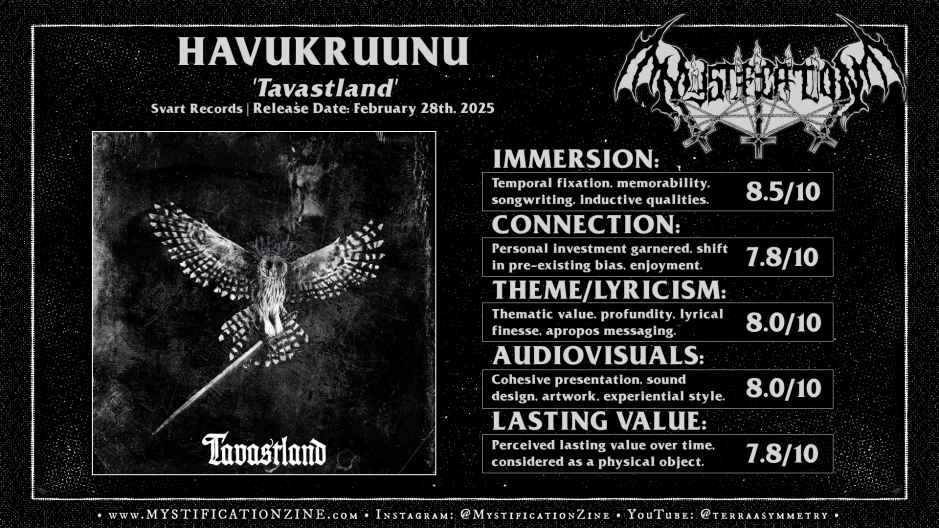
Your whole existence is contained, leashed to the point that the loftiest ambition you might manage under corporate boot and city lights is still pitiable slavery in the eyes of a truly free man. Recalling an age of mankind where tribes had the communal power and a sense of solidarity enough to walk their oppressors to an icy death in response to manipulation Hausjärvi, Finland-based pagan black metal quartet HAVUKRUUNU present a fourth full-length album meant to pry the eyes open and loosen the grip of greed’s shackles per their latest inspiring, might-filled songbook. ‘Tavastland‘ appropriately resounds with a sense of liberation, insight gained from a strong connection with the natural world intending to reawaken folks to the cold and pathetic reality of their lives lost within the black mirror.
Havukruunu formed circa 2005 after some formative work was done under the name Talvikuu via guitarist/vocalist Stefa who’d began collaborating and including other musicians beyond the first two demos he’d released in 2007, evolving from a raw and sombre black metal ideal toward pagan black metal ideation which is most clear on the third demo (‘Metsänpeitto‘, 2013). How far the band would take this sound on their fourth and most polished demo (‘Usvakuningas‘, 2014) is where legend began as the comparisons to Bathory and Moonsorrow were warranted as a combination of choral vocal arrangements, blasting melodic black metal sluice and the first of many distinctive black-and-grey illustrations from artist Heidi Kosenius to grace the covers of their albums. Call it a fluke of melodic metal trickle-down or just righteous heavy metal by osmosis either way the band had an inspiring sound which’d essentially act as blueprint for what their first three LPs (via Naturmacht Productions) would manifest.
The signature Havukruunu had developed leading up to (and realized within) their debut LP (‘Havulinnaan‘, 2015) wherein their earlier material was driven by melodic guitar voicing (see: “Aavevalo”) more often than not and became increasingly commanding in its striding heavy metal step. It’d be a wild point of reduction to suggest that this sound, with its distinct guitar tone and sometimes rocking leads, was following the usual Bathory-sketched template but it was and continues to be an obvious point of inspiration today. For a ten-year foundation built and a slow walk-up to this level of craft it’d been surprising to not see this band catch on with broader audiences via their second LP (‘Kell Surut Soi‘, 2017) which’d been unmercifully recommended to me by my own circle for the duration of that year. I’d considered it a feat worth mentioning next to the short list of “epic” and pagan/black side of things which so rarely side-steps vikingr/folk permutations. The crossing of the focused and aggressive guitar work and harsher black metal pockets melded with choral vocals was exemplar… and also familiar in its shape.
The wild and surprisingly not manufactured hype around the band’s “breakthrough” third LP (‘Uinuos Syömein Sota‘, 2020) came from a blend of emboldened performances, bigger-thinking vocal arrangements, and more elaborate production values. With the volume turned all the way up and all settings flipped bigger and better than before I’d found some of the dark, alienated furor of Havukruunu was trampled under hoof but there was no denying it was an inspiring release. It’d created very high expectations for what ‘Tavastland‘ would be five years later and it seems that the years between’ve propagated a call to the importance of place, to liberation away from societal conditioning and technology, and this should naturally feel like a wide pivot to a different shade of Quorthonian tapped cinema.
‘Tavastland‘ may be a purposeful ‘regression’ in terms of its theme, away from technology and the death-whirr of civilization, but longtime fans should find a few additional echoes from the past here. First, a lineup change per the return of bassist and former co-vocalist Humö who’d left ~after the first album, and second comes the suggestion that roughly half of the album was pulled from material written circa 2017-2018, rethought an rearranged. What this means for Havukruunu after a relatively long five year step beyond ‘Uinuos syömein sota‘ is an album that doesn’t double down on the maximal, forced production values of the previous album. Instead ‘Tavastland‘ should read like ‘epic’ viking/pagan black metal up front to most listeners beyond the spoken intro to opener “Kuolematon Laulunhenki” and the three songs which follow. This time around a warmer production value lends a less immediate, intense experience which is focused on telling a story rather assailing the listener with bombast. This leaves discussions of sub-genre largely uninteresting as the boundaries between heavy metal, pagan metal and early vikingr/folk black metal of the late 90’s/early 2000’s are blurred or smoothed over.
When do the swords begin to hit the shields? When do the ravens stop cawing their warning? I’m not sure this is that type of story though the real trample and battery occurs here in the nightside warning offered by key single “Havukruunu ja Talvenvarjo“. Here the light-footed step and the dramatic verse riff are instant in their appeal but still have some edge via harshened doubled vocals and double-bass drumming which (to me) signals something closer to the Swedish folk metal of the early 2000’s eh, sans any carnival keyboards and melodic death riffs… Somewhere in between mid-2000’s Thyrfing and Nokturnal Mortum‘s ‘The Voice of Steel‘ in tone and tradition. This is immediately followed by the title track, “Tavastland“, another key piece suggested to have been written years ago carrying some melodic black metal riffs as part of its anthem. Side A is obviously quite strong but did not deliver what I’d wanted from the troupe up front, presenting a congested opener and placing “Yönsynty” where it may as well’ve fallen out of ear after the two big singles that follow have made the biggest statements on album.
The chest-sung march that opens “Kuoleman Oma” is where my interest is most seriously piqued and the lead guitar screaming squalls that rush beyond ’til the end of the song with its intensifying lead guitar trade-offs make for a rush into Side B I’d found most entertaining with the context of each spin. “Unissakävijä” brings some of the band’s black metal directive back into view, a mix of melodic black metal and heavy metal in fine tradition another high point I’d wanted more of in general. Between the heavy rock solos and ‘epic’ chorales of this song I’d already found myself heavily preferring the second half of the album in terms of what I personally seek in approach of Havukruunu. The peak of this sensation comes with the 80’s heavy metal feeling stomp of ~11 minute closer “De Miseriis Fennorum”, compounding the Hellenic black adjacent ‘epic heavy’ sensation which bleeds through the whole of the flipside; Much as I’d enjoyed the singles on the first half of ‘Tavastland‘ the real “work” that’d built fealty and a strongest sense of their spirit-of-the-land messaging came on the second half from my perspective.
Since I cannot convey any themes or specific meaning beyond what has been assigned at face value, and have no clue on the lyrics themselves, I figure this album is most likely to speak to fans of the appropriate categorization one’d place on Havukruunu. This is not likely to plague the customer in the same way as lyrics will likely be included in the packaging, so, my experience is limited to skin deep observations and an appreciation for how this record fits into their greater discography. For my own taste ‘Tavastland‘ “corrects” and matures the band’s trajectory beyond the ear-catching buzz of ‘Uinuos syömein sota‘, which was also a good album, and another shard of their whole ideal moving away from black metal adjacent guitar-driven sounds. As such this latest LP won’t be so immediately redeeming to the ear sans the vacuum of loud and rushed-through presentation of some of their prior work. The main crossover of interest then becomes with fans of traditional heavy metal who are likely to find interest in pagan and folk metal ideals which likewise pull from the evolution of what Quorthon‘d built. I’m not yet sure if it’ll outdo the connection I’d had with the band’s second LP but it is yet a worthy addition to these folks’ name and thus far admirably stated discography. A high recommendation.


Help Support Grizzly Butts’ goals with a donation:
Please consider donating directly to site costs and project funding using PayPal.
$1.00
Make a one-time donation
Make a monthly donation
Make a yearly donation
Choose an amount
Or enter a custom amount
Your contribution is appreciated.
Your contribution is appreciated.
Your contribution is appreciated.
DonateDonate monthlyDonate yearly mystificationzine.com