
• AN EXHAUSTIVE STUDY: Here I present Part VII of a series of a comprehensive sub-genre analysis features that began back in 2015 (Technical Thrash Metal, Melodic Hardcore/Skatepunk) on another site. This second pass for Melodic Black Metal will be a more comprehensive redux of the series which began back in 2017 and generally completed in 2018 wherein seven enormous entries detailed key releases from 1991-2005. It is necessary to rewrite, ‘remaster’ and approach this subject another time due to the old columns no longer linking to their album artwork, most of them weren’t very thoughtfully written, and the type of posts used were not created for mobile readership rendering them impossible to read. This will not be a plain recreation of that list but rather a more complete, far more in-depth format which makes less of an effort to draw the line between sub-genres and instead aims to better understand the delineation between melodic black metal and the general evolutionary origin of the sub-genre next to many others.
The method for this type of feature is simple: I procure a chronological list of demos, EPs, splits and full-lengths from various sources. I then re-listen to every release in order, research each band, and report my thoughts and observations including trivia and any relevant context. This time around I will include ~6-10 items per entry and each one will (eventually) include a short video. Instead of deciding if these releases truly resemble the sub-genre suggested per available public databases (Metal Archives, Discogs, Rateyourmusic, etc.) I will further make the argument for what releases I believe are in keeping with the canonical highest standard, identifying influential or important items for the melodic black metal form. This should allow some understanding of this musical style and the need for distinction between subculture movements in underground music and the incessant waves of imitation beyond the original thought. — This entry will continue to consider the sub-genre in its formative stages and will call for at least some general narration of the various black metal scenes, styles, and trains of thought which lead to certain bands being labeled “melodic” then and in hindsight. Level headed, respectful feedback is welcomed by way of grizzlybutts@hotmail.com
If you missed Part VI, which covered the second third of 1994, catch up here:
An Exhaustive Study: Melodic Black Metal Redux [Pt. VI] – ‘Night’s Shade Befalls the Holy’
MCMXCIV – Cresting the Wave
If you missed the first six months of Anno 1994 CE per the last two parts I’d more-or-less set the scene for the year in black metal in general, discussed the diversity available and pointed to a handful of albums that were essential to my own taste. Refer to the previous parts, V & VI, for that information. Otherwise much of what I’d covered related to Scandinavian black metal with only a couple of detours to the Mediterranean, eastern Europe and the United States. This time around we take a look at a number of low-key classics, foreshadowing for lasting careers at the forefront of melodic metal, and the true birth of a few monstrosities. This also marks the point in our conversation where we begin to see a more determined shift toward black metal without black/death metal factoring into view unless we are addressing the still-flowering evolution of Swedish melodic black/death metal.
Please note that this entry is about a month overdue and largely because the 2024 release schedule has taken a good share of my time and interest of late. This is the final entry in “Season 1” and to finish the thought 1991-1994 of this version of An Exhaustive Study: Melodic Black Metal in redux a cumulative ‘essentials only’ column will be the main feature of Mystification Zine Issue IV. This will only concern itself with prime selections of what I’d consider canonical and important examples of melodic black metal in these formative stages. Before the likely much longer Season 2 (1995-2000) commences we will briefly shift gears to another topic.
NOTES: There is thus far one 1994 released tape which I’ve no access to: [1] Vinterland‘s ‘A Castle So Crystal Clear‘ though I had seen copies of it floating around on old filesharing blogs back in the early 2010’s. [2] Saxorior‘s ‘The First Fight‘ demo tape, though I am pretty sure they were just a thrash/death band with keyboards at that point.

‘Daemoonseth – Act II‘ was recorded at Modern Sound Studio in Gdynia, Poland from June 20th – July 5th, 1994 and it features in their discography as arguably the most accomplished and best realized version of what Cezary and Christ Agony had been working toward since forming. At the very least it is definitively the major accomplishment of the original trio, here accompanied by engineer/producer Tomasz Bonarowski (R.I.P.), who’d been a key component of Vader‘s production on ‘Sothis‘ / ‘De Profundis‘ around that same time (see also: Mortify ‘Abyssal‘), for the intro/outro compositions. Here we get the black-doom, the gothic metal indulgences, and the black/death metal lurching that’d all contributed to their surreal yet now sophisticated sound. While it might seem like a stretch to consider this band’s output primarily melodic on the walk up to this point this album makes reasonable feature of these elements when we consider their spot next to Swedish, Greek and Swiss bands from similar points of origin.
The approach of the band would clearly change beyond this point as the bassist/vocalist appeared to fully take the reigns and different musicians soon entered the fray, so, we will still have some reason to follow their discography beyond this point (at least to Act III) but it is worth taking in the scenery, the atmosphere and the ultimate realization of some of these songs which date all the way back to the bands most primitive and muddled demo days. In general the step from ‘Unholyunion‘ (1993) to this record could be equated with the step from ‘Thy Mighty Contract‘ to ‘Non Serviam‘ which we will likewise discuss shortly but we should also take into account how this band represented interest in many scenes, many sounds, and wasn’t concerned with trying to fit into anything but their own skin.
More Info:
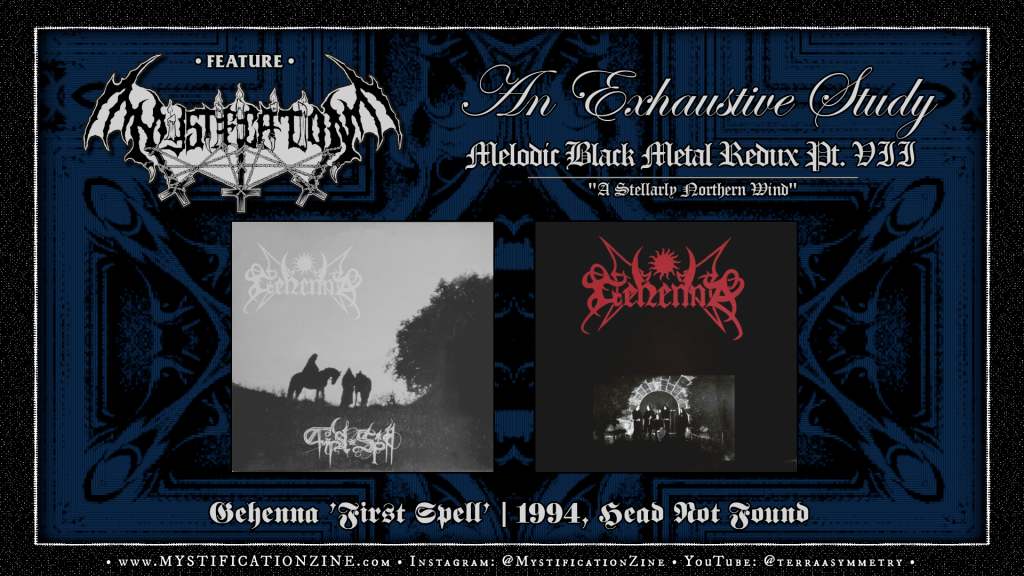
The debut EP from Stavanger, Norway-borne group Gehenna was recorded at Soundsuite Studio from the 3rd ’til the 7th of July 1994. Apart from a nearby rehearsal tape this would be their first release to feature now accomplished and well-known drummer Dirge Rep. My appreciation for ‘First Spell‘ runs deep thanks to its haunted yet entirely tuneful organ grinding and traditional yet folken heavy metal riffs (see: “Unearthly Loose Palace”) which’d aligned with my favor of Ancient‘s work as well as predisposing me to be an adoring fan of everything from Falkenbach‘s debut LP to the early works of Black Magick SS, setting a certain standard for tunefulness and complex melodicism of its own type. Back in the day, and for me it was the early 2000’s when I discovered this album, it still felt like a lost gem and an obscure release that folks had shoved aside and not appreciated for its unique character in the past.
As I often the case, I do -not- recommend the remastered version(s) of this album. Though any remaster will do in terms of providing a serviceable render there was never any need to peel back the grime and vigor of this particular old work. The obfuscation of time is valuable in its patina and that original sound, “imperfections” and all, is where I’d connected with this music. If you can only find later version of the album get the 2012 double LP from The Crypt, this is per my own experience the ideal form and it includes the 1993 demo tape ‘Black Seared Heart‘; While I will likely speak to each of the first three spells of this band I’ve included this EP for the sake of it being inherently melodic, guided by its melodic statements as a point of purpose, though one could argue there are plenty of other sub-genre notions that could be applied to this record in hindsight.
More Info:
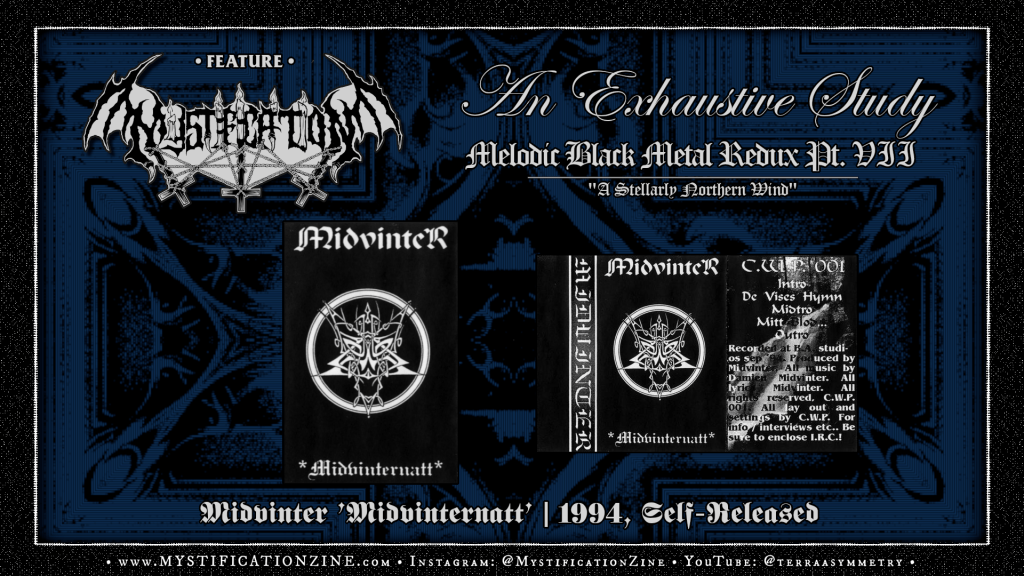
This very brief ~9 minute demo tape was recorded at B.A. Studios in September 1994. Karlskrona, Sweden based trio Midvinter was the vision of one Damien Midvinter (aka Mikael Andersson) who’d formed the band in 1993 enlisting original vocalist Vlad Morbius and drummer Krille (Melek Taus) who’d also featured in another related project Apollgon (a black/death metal band) which they’d developed more-or-less in tandem. The separation between their death metal and black metal projects were not only pronounced but impressive in their early development but this isn’t necessarily the recording that’d made Midvinter a somewhat curious, potentially ambitious name in Swedish melodic black metal. We’ll have to wait until 1997 to get to the heart of that interest. Here we find relatively well composed albeit cursory guitar work with some strong feeling behind its composition with the keys-girded choruses of “De vises hymn” acting as the major point of promise on this tape, the greater shape of this song speaks to lessons learned from melodic death metal as I hear it but ‘Midvinternaat‘ always stood out more for its interstitial sound collages which seem to depict a beast trudging to its dungeon, the screams of torture within said cavern, and a bombastic march unto the end where a village is burned … something like that, there is a bit of horrified cinema in the way the experience is framed and I’d always wanted more of that on the LP.
I’ve included a link to the ’93 Apollgon demo tape but I’d suggest seeking out the 1995 tape as well if you’re looking for the full picture of what they were up to in the mid-90’s.
More Info:
YouTube: https://www.youtube.com/watch?v=w8J8grznSgY
Apollgon 1993 demo: https://www.youtube.com/watch?v=uXviKRXJdus
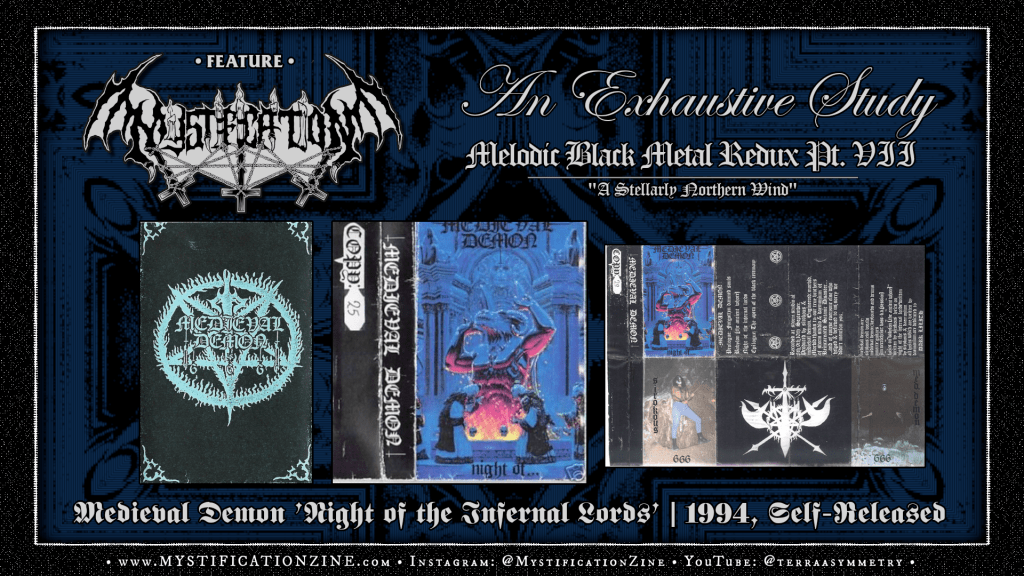
Medieval Demon are an Athens, Greece bound entity formed back in 1992, you should recognize them if you checked out Invocation‘s split with the band earlier in our exploration of 1994. Recorded at the infamous Storm Studio from September 8th-10th in 1994 this tape was originally just ‘Medieval Demon‘ before it was generally referred to as ‘Night of the Infernal Lords‘, named for a song which was the main proponent of their split. There are three versions of this tape that I know of wherein the original self-titled run was photocopied, the third run was photocopied with a different cover, and the second version was a pro-tape with a cool-as-shit painting on the front and the title ‘Night of…‘.
The main thing to note here is the over the top screeching vocals of Sirokous and otherwise we find the charm of Storm Studios production in full effect here with dissolving guitar tones, a well-set bass guitar sound, and I’d always appreciated the stomping feeling of the drums here. If you’re not familiar with this band and their discography you’ve missed a truly compelling sect from the early Athens scene who have persisted since, even having released a few full-lengths in more recent years. This tape is not inherently melodic to the point that their style perfectly fits our discussion but I’d felt it was important to include some additional Hellenic black metal presence to juxtapose against the ongoing refinement of bands like Rotting Christ at the forefront. There were many obscure and esoteric bands in this scene (see: Zephyrous) doing fine work but only a few found a direction that had any chance of becoming widespread. So, if you’re under the impression that the Athens scene all sounded the same this is a great example of how each band used those resources in different ways for different results and perhaps arrived at the studio at different levels of preparedness.
More Info:

Umeå, Sweden-based crew Naglfar formed under a different name (Uninterred) as a quartet which included members of other bands who’d formed around the same time, such as Nocturnal Rites and Ancient Wisdom. By the time this demo tape was recorded at Garageland Studio (September 14th-16th 1994) their drummer had left and vocalist/keyboardist Jens Rydén ended up programming the kit. This was obviously coming from intrepid folks who knew what they were doing as ‘Stellae Trajectio‘ was not only impeccably rendered and written but it was first sent out in a unique promotional tape for zines which was then followed by this “public” version of it on a professional tape (originals were transparent purple) with a slick layout.
Their work is not always regarded all that highly beyond 1995, often simply passed off as a Dissection-alike release by the thoughtless, but this entirely relevant precursor to ‘Vittra‘ (1995) shows some direct connections made between the escalating and complex melodic phrases of Eucharist‘s early years (“Sunless Dawn”) and the power-metallic resolve of those phrases into dramatically arcing melodic black metal, reinforced by rawly rasping vocals and the dungeon synth level glisten of their keyboard work. There are two main pieces here which sell the major personality of Naglfar here starting with “Enslave the Astral Fortress” and ending with the over the top “The Eclipse of Empire Storms” both of which are arguably one of our first examples of outright melody driven black metal which appeared to have that intent by design, writing immediately catchy songs which likewise matched the bluster of say, early Cradle of Filth on some level. Since most of these songs end up on their debut, this is only essential for contrasting some of the decisions they’d made when recording their full-length.
More Info:
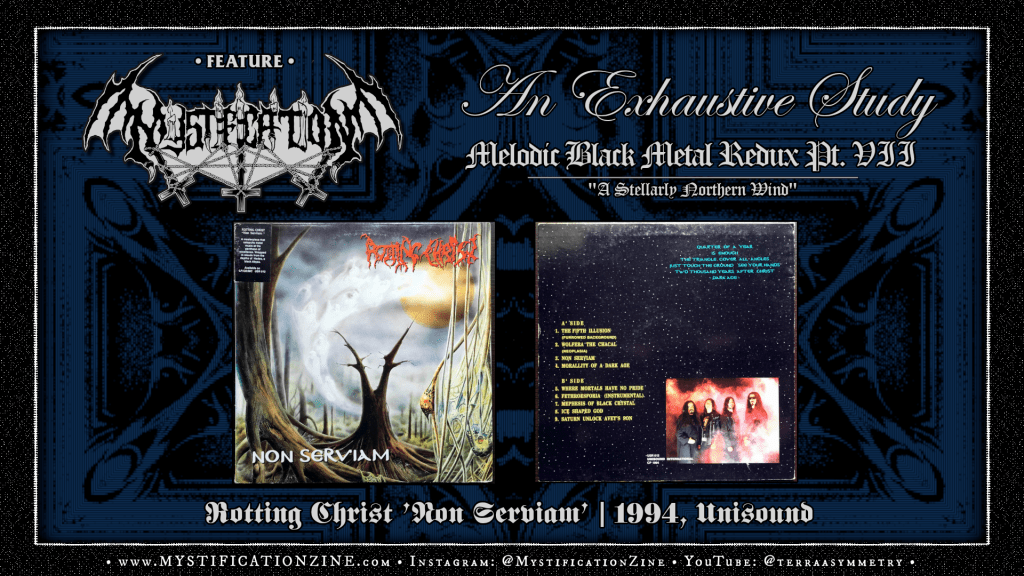
Among a small handful of the most essential, original, never replicated points of defining magickry from the original guard of Hellenic black metal ‘Non Serviam‘ is a bit of an unholy throne for niche enthusiasts in hindsight with its unique mid-paced yet thrashing approach to melodic metal blossoming herein. That said, this result was still far from the goals of the seeming perfectionist/visionary folks behind it. A self-produced and Storm Studio-recorded album which is suggested as their peak interest in the tenets of LaVeyan Satanism between its core membership we find this album so focused on its melodic development in tandem layers that it creates a surreal harmonic relationship which is difficult to relate to other artists at the time. This paired with a unique rhythmic structure via a well-tuned Frankenstein’d electronic drum kit (the cymbals were real) is a natural leap beyond ‘Thy Mighty Contract‘ in terms of crafting more active density within a sound many considered limited at the time. Much like Varathron‘s composers at the time one could still feel the inspiration of thrash, heavy and doom metal in their compositional tics alongside the first shades of gothic metal interest.
For a clear enough point made on this being an exemplar piece of melodic black metal we have an oft-overlooked counterpart directly from the folks involved in Thou Art Lord ‘Eosforos‘, another personal favorite record of mine from this scene, which provides the perfect tonal counterpart from the same hands though I have always felt this album’s material was better rehearsed and more sure of itself beyond some crooked soloing to start.
The band’s original sound was most clearly in development and defining itself between 1991-1996. If you’re of the lot who believe ‘Triarchy of the Lost Lovers‘ improved and perfected this approach, eh, I love that album and generally agree they’d built upon those guitar techniques and melodic shapes… but if I recall correctly the band felt that record was flawed and rushed by the label (Century Media) at the time, too, and might not’ve been happy with the intended result until ‘A Dead Poem‘.; For the sake of trivia, most of which is better left to their official biography, ye olde complaint is that Unisound Records hadn’t budgeted widespread marketing off the back of the popular tour that’d preceded the release of this album and as such the band felt the momentum this album could’ve provided was lost.
More Info:
YouTube: https://www.youtube.com/watch?v=PY9BO5VzsT4
Thou Art Lord ‘Eosforos’: https://www.youtube.com/watch?v=-Pp04D0hQhM

At a quick glance it would probably seem easy to categorize the four year lifespan of Luleå, Sweden-borne melodic black/death metal band The Moaning as a crew who’d done well to stand their ground within the then peaking No Fashion stable but as we seek out context we find a quintet of folks who had their hands in a seeming entire scene unto their own as we count the namedrops. Formed in 1993 between folks who’d been associated with death metal band Decortication (previously Gilgamosh) by the time these folks had recorded this demo tape in October of 1994 (Musikhuset in their hometown) they’d already spread their membership into Satariel, Gates of Ishtar, and I believe The Everdawn too yet I don’t know much about that group at this point. The style of this demo tape is well formed, a darker shade of the style bands like A Canorous Quintet and Gates of Ishtar are best known for in the sense that various shades of death metal swing-and-groove per the times interrupts the rasping furor of their approach. Hearing these pieces stripped down to demo level bones helps to highlight some of their thrash and death metal influences riff-by-riff but also the sophisticated momentum created, and this comes with some representative Swedish death metal moments along the way. Also, cool-ass logo. — We’ll have more to delve into once we hear this personae realized once (and only once) on their 1997 debut LP
More Info:
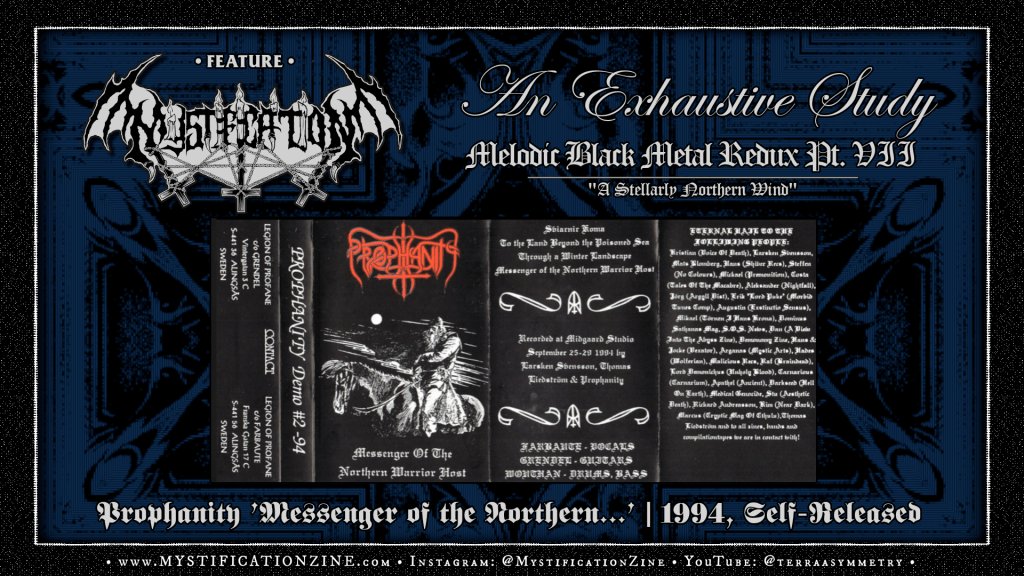
Formed circa 1991 in Alingsås, Sweden but without a completed line-up until 1993 Prophanity, much like Twin Obscenity, were unfortunately labeled as a Vikingr death metal band once they were noticed in the late 90’s and this’d caused folks to generally overlook their beginnings as an aggressive black metal band. Leading with pagan themes and bringing the tumult of Swedish black/death metal in tow this has long been a random connection made on my part in terms of demo tapes from this period that present an idea that was ready for an album’s worth of variation from my point of view… and judging by my reaction to the first Dawn LP you’ll understand once you’ve hit songs like “Through a Winter Landscape”. You can tell the allure of early Marduk, the influence of thrash and of course Bathory, alongside the emerging melodicism nearby all feeds into this tape for a result I’ve always found spirited but, sure, not yet complete in its conception.
‘Messenger of the Northern Warrior Host‘ was recorded from September 25th to 29th, 1994 at Midgaard Studio in Alingsås, Sweden. Released via two editions both on plain black tapes with pro-printed covers, the logo was red in the original set and then changed to blue for the more rare second edition. I am generally looking to collect anything related to this band prior to 1998, specifically the blue logo version of this tape as well as the 7″ that followed in ’95. They’d released on demo before this, ‘Demo #1‘, earlier in 1994 but this is a superior statement which improves upon most of the same ideas.
More Info:
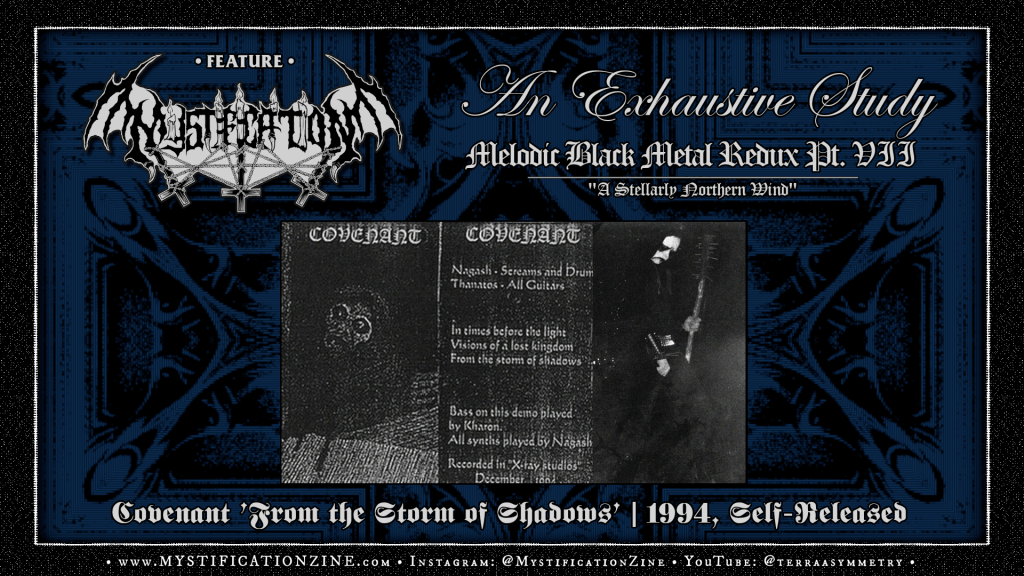
Hamar, Norway-borne duo Covenant originally formed as a death metal band in 1992 per the vision of a then 14 year old Nagash (Stian Arnesen) who was then joined by Thanatos aka Blackheart (Amund Svensson). That original line-up included a drummer who went by Shnaga that’d been ousted from the band after they’d recorded an unsatisfactory scrapped demo tape (reportedly titled ‘Hatred‘) in early 1993. By December 1994 they were a black metal band which’d blurred the lines between the keyboard-lead style that’d been forming around this time (“symphonic” melodic black metal) and a more typical form of black metal rawness came to fruition nearby in Nagash‘s Troll. Since I’ve very little to say about this band beyond their debut LP I suppose the thing to note is that while Covenant continued to evolve towards an award winning industrial metal band Troll became the intermittent depository for the spirit of this earlier material, generally speaking.
Recorded in X-Ray Studios in Rolvsøy, Norway in the grip of winter ‘From the Storm of Shadows‘ has a cold yet commanding presence between its room clapping drum sound, doubled and throaty vocal rasp, and dreary use of keyboards. If we were to take on a closer inspection of what’d been happening in black metal en masse circa 1994 this was mostly notable for its slinking mid-paced guitar melodies shaped on two guitars but of course we must concede to the very well arranged alignment of the keys as the main melodic device. Though Dimmu Borgir and Old Man’s Child had a bit more fire in their blood at this point there is still room to consider the early ambitions of Covenant and their strange history beyond this entrance.
More Info:
YouTube: https://www.youtube.com/watch?v=kVC-WVotcwA
Troll ‘Trollstorm over Nidingjuv’ demo ’95: https://www.youtube.com/watch?v=QjPmn3mOpzU
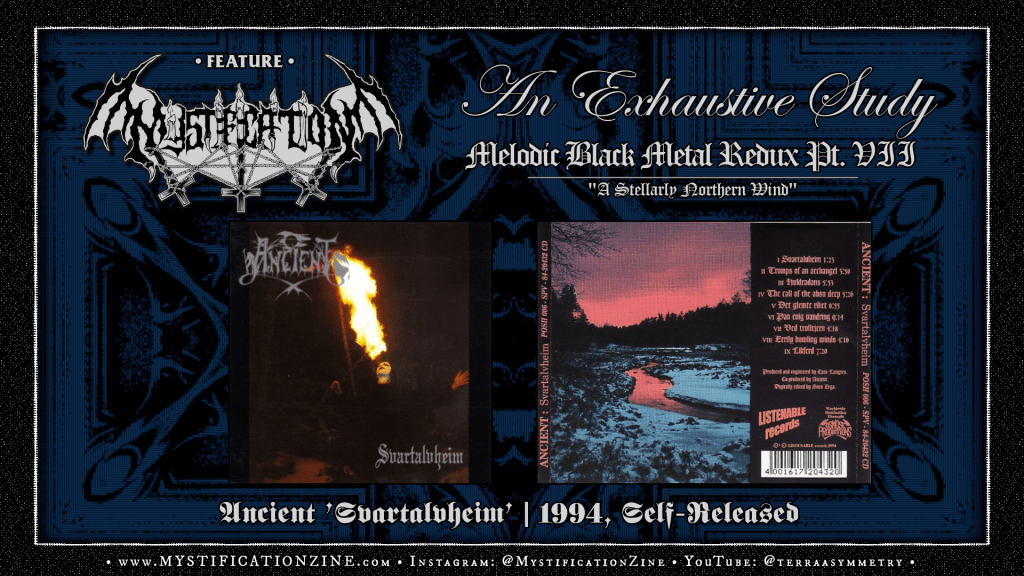
When it comes to the legacy of this debut full-length from Ancient we are presented with the unusual prospect that Norwegian black metal could in fact be a consistent experience of pleasurable mystic charm, a circular dance ebbing away from the percussive charge of the time rather than creating raw juxtaposition with it (see: early Ulver). That isn’t to say that they’d set this precedence themselves but rather that an album like ‘Svartalvheim‘ truly found its peers in Bathory-infused pagan black metal (they’d worked with the same producer for Aeternus‘ ‘Dark Sorcery‘) and arguably some kismet with the spiritual dramatism of the Hellenic scene, at least when we look to the mid-paced thrum of songs like “The Call of the Absu Deep” and consider the folken chord progressions available to the rhythm guitar work. Contrary to the usual cursory examination of this band’s discography (which plainly compares it with the usual entry level subjects) we can and should consider the era of Aphazel and Grimm ’til 1995 an original addition to Norwegian black metal, not only for their oddly catchy approach to heavy rock and folk influenced guitar work (“Det glemte riket”) but for the blunt yet highly sentient result of this album. If you’re not getting the melodic black metal tag right off the bat, wait for the full album to finish playing before you decide; ‘Svartalvheim‘ was also notable as one of the earlier releases from French label Listenable Records who were never particularly known for black metal but had a great track record for underground gems during their build-up in reputation beyond the mid-90’s.
More Info:

Recorded during Summer of 1994 at The Dungeon in Arlington, Virginia this second demo tape from USBM legendry Grand Belial’s Key is only relevant to their first phase of development beyond the core duo of guitarist Gelal Necrosodomy drummer/vocalist Lord Vlad Luciferian wherein bassist/keyboardist and co-songwriter Demonic appeared to elevate some of the rhythmic aptitudes beyond their 1992 tape. A professionally pressed tape which came from the early days of still-active Polish label Pagan Records ‘Triumph of the Hordes‘ is frankly -only- interesting because of Necrosodomy‘s heavy metal built guitar work though there is obviously some strides in aptitude made otherwise. The core intent of the band is not squarely set upon melody making but it would be disingenuous to not acknowledge this band’s contributions to melodic black metal guitar work.
After this point Cazz Grant of Crucifier would take the place of vocalist/drummer Lord Vlad Luciferian who would then join Ancient and feature on ‘The Cainian Chronicle‘ (1996) afterwards. This meant a more musically apt and certainly over the top vision from the band, so, while this demo is part of their greater infamy it was merely a status check for the groundwork being done for songcraft and the original style/sound of the band does not fully reveal herein.
More Info:

Before I’d ever seen Jessheim, Norway-borne trio Dimmu Borgir labeled as “symphonic” black metal they were most often included in the most classic description of “atmospheric” black metal and this will make more sense as the extended intro of this debut 7″ record reveals itself. Recorded at Stovner Rockefabrikk in August 1994 these ~two pieces make the case for what was unique about this band early on, certainly not their compositional sense of action on the guitar but rather the dramatically glowing atmosphere provided by luminous keyboards and ‘epic’ arrangement. Granted “Raabjørn speiler draugheimens skodde” has a bit more of a direction to take with its Venom-esque kick on the drums but the goal here was not to show their entire hand as they’d built up toward ‘For All Tid‘, an album which’d overflowed with too many ideas by comparison. If you’ll take the time to sit through some of their 1994 rehearsals preceding this point the tact of this release begins to make more sense as a preamble, though the songwriting on this 7″ is nowhere near as exciting as what we find on their debut LP. This release is largely coveted for its evocative cover art and extreme rarity as one of few releases from Necromantic Gallery Productions, a short-lived Netherlands-based label who’d also released early minor releases from Gehenna, Ulver, Einherjer, and Mortiis‘ industrial side-project Vond. From my point of view it isn’t necessarily worth ~$250.00+ USD for a copy of the original run.
More Info:
This is the final entry in “Season 1” and to finish the thought 1991-1994 of this version of An Exhaustive Study: Melodic Black Metal in redux a cumulative ‘essentials only’ column will be the main feature of Mystification Zine Issue IV. This will only concern itself with prime selections of what I’d consider canonical and important examples of melodic black metal in these formative stages. Before the likely much longer Season 2 (1995-2000) commences we will briefly shift gears to another topic. Please note that if the readership just isn’t there for these types of features I will simply pivot to other ideas, no guarantees.



Help Support Grizzly Butts’ goals with a donation:
Please consider donating directly to site costs and project funding using PayPal.
$1.00
Make a one-time donation
Make a monthly donation
Make a yearly donation
Choose an amount
Or enter a custom amount
Your contribution is appreciated.
Your contribution is appreciated.
Your contribution is appreciated.
DonateDonate monthlyDonate yearly mystificationzine.com