
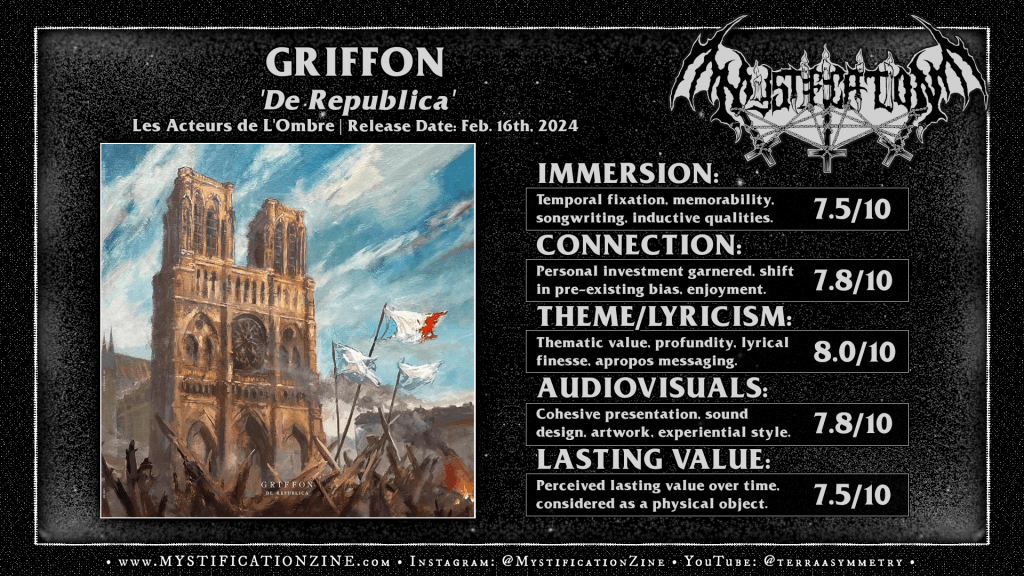
A government which refuses to work together, engages in no level of compromise and side-steps any reasonable level of civility cannot represent the interests of its people. In every case this level of dysfunction is by design the will of the ruling class, the eternal filibuster of a nation into ruin which has been the only partially effective strategy to stifle the inevitable change looming over France these last ~hundred years. Intending a progress report on revolutionary activities from the collapse of the Roman empire ’til today Paris, France-based melodic black metal quartet Griffon return for a third full-length album which glorifies the will of the republic as a bastion of revolutionary action. Though its innards may prove a bit “moderne” for some black metal fans ‘De Republica‘ serves as a reminder that without community engagement, civil duty, and striking back at the self-appointed powers that be that life under thumb will inevitably serve as perpetual cage for complacent, subservient men.
Formed circa 2013 with vocalist Aharon (A/Oratos, ex-Geisterfels) and guitarist Sinaï (The Order of Apollyon, ex-Moonreich) as the collaborators at impetus Griffon have long presented a Scandinavian and French black metal inspired sound which has arguably become more accessible in terms of melodic emphasis and production values with each release. Their sound could be described as something like the neoclassic evolution of Sognametal per Cor Scorpii tempered to the pagan black melodicism of Artefact, at least if we consider where they’ve ended up on ‘De Republica‘. They’ve their own depth beyond those general markers, of course, but thus far it has arrived via themes which I’d describe as focused on European social history, more specifically events or ideologies which shaped the modern “western” world and of course from a French perspective. Beyond their first EP their concerns began with the syncretism of pagan religion under the control of invaders, the loss of idiosyncrasies and specificity of cultures as they were systematically amalgamated by conquerors and invaders per their debut ‘Har HaKarmel‘ (2016). The deification of politicians, rulers proposed as Gods or “chosen” as the vessel and/or interpreter of divinity on their impressive second LP (‘ὄ θεός ό βασιλεύς‘, 2020). My review of that second album did well enough to parse through past and (then) present work from the band but ultimately found the album just a shade above average for French black metal, not having returned to it more than a couple of times beyond review. Refined but still noisome production values, elaborate song structures and harder hit pace are traits which have me appreciating that second LP in retrospect, enjoying the havoc and the musing asides it’d taken despite a strong melodic focus.
Naturally, there is no reversion intended their realm as Griffon presents album number three with their most idealistic spark to date in terms of its themes and a decidedly accessible and dramatic level of melodic bombast with which they frame them. This will be outside the realm of interest for folks looking for the darker, twisted impingements of melodic black metal and pagan black metal found on their earlier work and instead hint at a more standard “melodic metal” crowd with easy to approach, simple rhythms and neatly arranged lead guitars as the main focal point beyond the narrative itself. What does this mean, for those who can’t necessarily read between the lines? Big, slow and chugging rhythms and polished sound that’ll put off folks looking for a more organic result. As we step into the rolling, chanted rouse of opener “L’Homme du Tarn” the spoken narrative, clean vocals, and roar of the heavier verses do well to show the increasing range of Aharon though this presents something more outwardly performed than the prior LP, not exactly anthemic but presenting a dramatic entrance in three main waves. Though the clean vocals and folkish group-sung bits aren’t exactly Vintersorg in their design the effect of the opener is compelling in a similar way.
“The Ides of March” introduces the distant, performative feeling of ‘De Republica‘ and its compositions by way of its cinematic focus wherein wide angled scenes of marching boots and quotes taken from the assassination of Julius Caesar indicate a trip to the lyric sheet is necessary. This is perhaps were the band would begin to win me over in terms of their poetic treatment of what is essentially centuries of embattlement between the ruling class and those seeking social democracy. From pre-World War tensions to the fall of the Roman empire and through the 18th and 19th century revolutionary events they present, and explain the significance of these events in shaping the social freedoms people in France still fight for, including more recent examples of the separation of church and state as well as closing piece “De Republica” referring to the diminish of authoritarian power of its presidency. The presentation of this theme is at times far more interesting than the rhythms of the music beneath it, such as the bland chugging riffs on the second half of “La Semiane Sanglante” which begins with an active, uptempo melodic death gallop but eventually ends on a blunt, dull note.
Griffon just as easily enchant within their more atmospheric pieces such as the slow-fuming build of “La Loi de la Nation” with its neatly stated dual guitar phrasing and searching leads and this is where they make good on the promise of some of the earlier standout moments on the album, though it feels like they’ve gotten distracted along the way. In making the choice for narrative, theme and an involved presentation they’ve simultaneously taken on rhythms which interrupt both the tragedian and the heroic tone of ‘De Republica‘ with a bonking, modern metal aftertaste. The final moments of closer/title track “De Republica” is unsatisfying in this regard, chugging on a very DSP sounding guitar tone in a way which is entirely unrelated to black metal. At face value it’d been a potentially grand showing with an inspired set of narrative ideas behind it but this album soon fell out of rotation after I began skipping past its dragging modern non-riff moments. Still, even if it wasn’t exactly to my own preferences there is some strong curation and craft here with great meaning attached to their work. A moderately high recommendation.



Help Support Grizzly Butts’ goals with a donation:
Please consider donating directly to site costs and project funding using PayPal.
$1.00
Make a one-time donation
Make a monthly donation
Make a yearly donation
Choose an amount
Or enter a custom amount
Your contribution is appreciated.
Your contribution is appreciated.
Your contribution is appreciated.
DonateDonate monthlyDonate yearly mystificationzine.com