
N.B.B.M.N. is Nothing But Black Metal November, a themed short reviews column which I’ve been doing since 2015 in various venues, initially inspired by friends of mine who’d often spend November only listening to black metal and generally catching up on the releases they’d missed throughout the year. This third entry covers mostly random Bandcamp grabs, stuff that was recommended by readers, and some requested submissions. // I’ve done my best to showcase the most interesting works that I come across while still presenting some decent variety but choices boil down to what sticks, what inspires or what is worth writing about. These reviews are more easygoing than longform reviews, so relax and think for yourself. — If you make music in this style and would like your music reviewed, read the FAQ and send promos to: grizzlybutts@hotmail.com
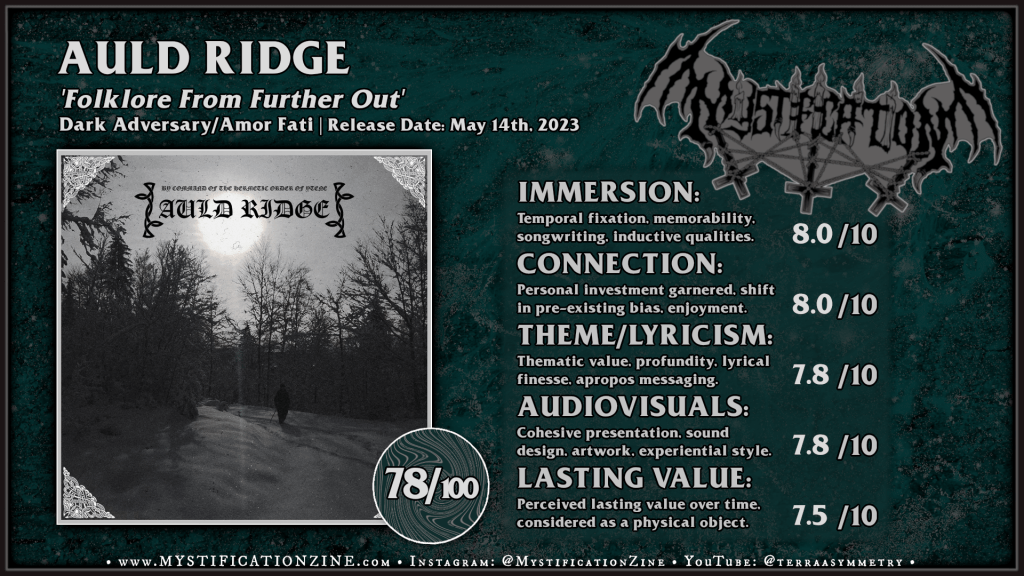
Auld Ridge comes as an newer atmospheric folken side project of British musician O.W.G.A. who is best known for his work in Albionic Hermeticism (who’ve also their own 2023 LP) since 2018 or so. With four albums produced to a very high standard in the last four years most of the material we’ve gotten from this project was composed and recorded in 2021 as far as I’ve gathered and likely pursued either during or in response to the pandemic pause. ‘Folklore From Further Out‘ reads to me as what I’d consider an updated vision of mid-to-late 90’s pagan black metal at face value per its oaken use of acoustic guitars, an inquisitive yet triumphal tread to its oft melodic riffcraft, and especially fine treatment of the rhythm section. As we stretch past the first couple of pieces “The Sound of the Fyrth Begins to Creep” takes us to an differently thawed patch of grass, slightly more vivified and intense than expected while keeping with the general tenets of 90’s revisionism per its less than stealthy use of synths to generate interest in the first few verses. The appeal of this release is broad in terms of its classicist traits, the dynamic will read about as conjunct as that of Ulver-attuned black metal of the late 90’s but the meat of their riffcraft is very lightly rooted in the excitable rise and fall of “medieval” melodic black metal per France/Quebec or nearby. I’d found this album entirely enchanting for its depth of production values, well chosen synth presence, and the guitar driven cut of the longer pieces included.
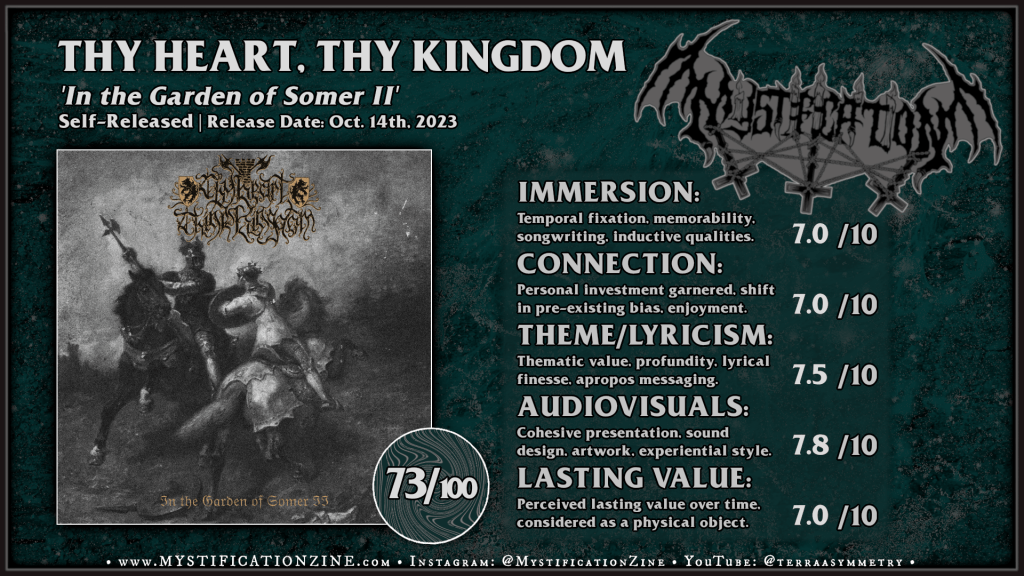
Thy Heart, Thy Kingdom is a side project between members of Till and the vocalist from Calling of Phasmic Presence wherein these folks who’d seemingly discovered black metal through the sopping, unintelligible rawness of pandemic era ‘limited edition’ vampyric bestsellers create derivative raw black metal. If you must have more along the lines of the pre-LP phase of Wampyric Rites and early Lamp of Murmuur, this is similarly buried by digitally applied lo-fi render (“laptop mic rawness“, as I call it) in order to generate atmosphere around relatively bland composition. At some point this type of guitar work feels forced and the vocals kinda confirm this isn’t serious gig but a fun collaboration between artists. The design of the cover art was compelling enough to warrant checking this one out, and I’ve no doubt there are still plenty of folks who’re still finding some value in this well-worn path, but it wasn’t for me.
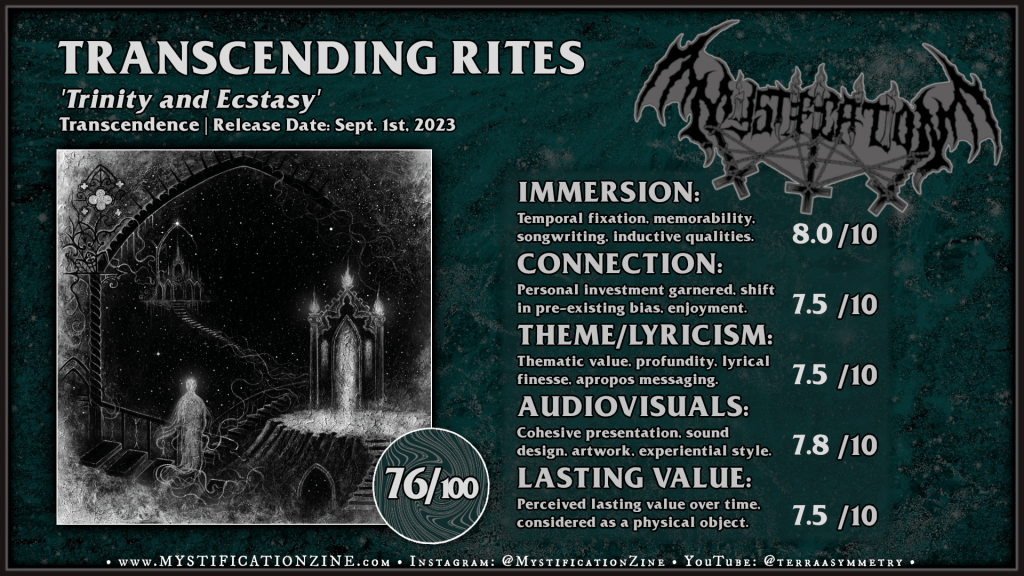
Transcending Rites is an atmospheric black metal duo split between the extremely prolific Déhà and French artist Brouillard, who runs the Transcendence imprint alongside several of her own projects, and this is their third full-length album in three years. ‘Trinity and Ecstasy‘ concerns itself with a primarily linear path which is not uncommon of each musician’s atmospheric ideal wherein a corridor of rumbling sound becomes an ever elusive focal point to fixate on. In this case the two pieces here are singular in thought but not static in movement lending a sensation of constant momentum built, particularly on Side B wherein “Ecstasy” would end up dominating the experience with its rabid pace, hints of choral interjections, and venomous vocals snarling throughout. The overall effect is haunting, simple but effective for the most part. I’d like to have heard much more definition in at least one of the thousand humming guitar layers and I suppose I can’t fault the sub-genre standard rhythm section which functions as little more than a flat and dry plane.
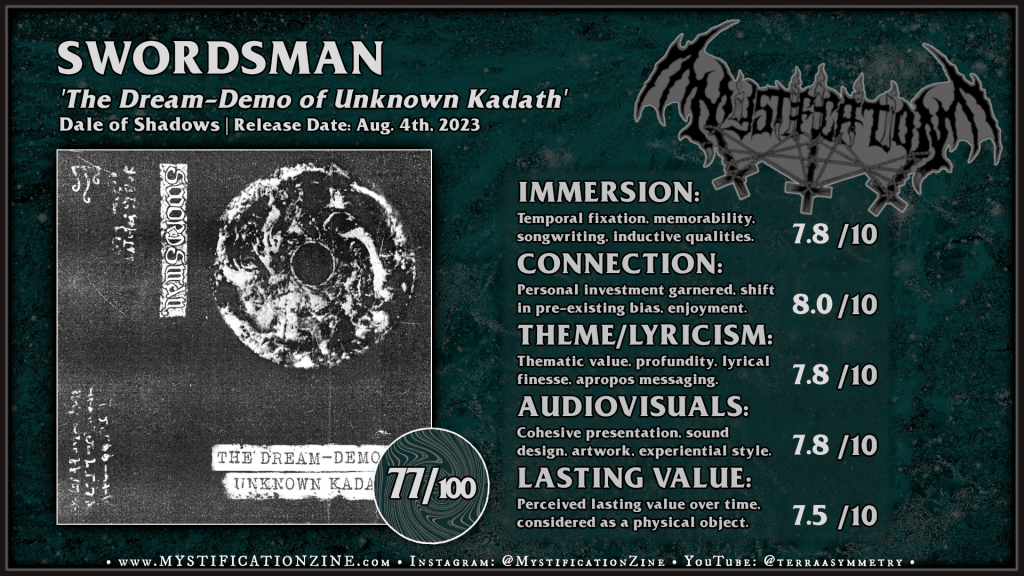
Swordsman is an Ostrava, Czechia-based project from Jan Sludged who describes their sound as raw black metal infused with elements of punk and dungeon synth. ‘The Dream-Demo of Unknown Kadath‘ follows their 2022 Escafismo Records released debut CS as a true demo with rough versions of pieces which appear fully formed and heavy on the tape hiss, warped sounds, and kicking mid-paced aggression. I appreciate their dedication to organic and humble recording sounds as I’d never felt this obscured the impact of the music even in this skeletal state which bears a ton of charm per its old leaky synths and strangely low-set roars. Had to crank this one really loud to get the full effect but I had a great time with. Check out their first LP, too.
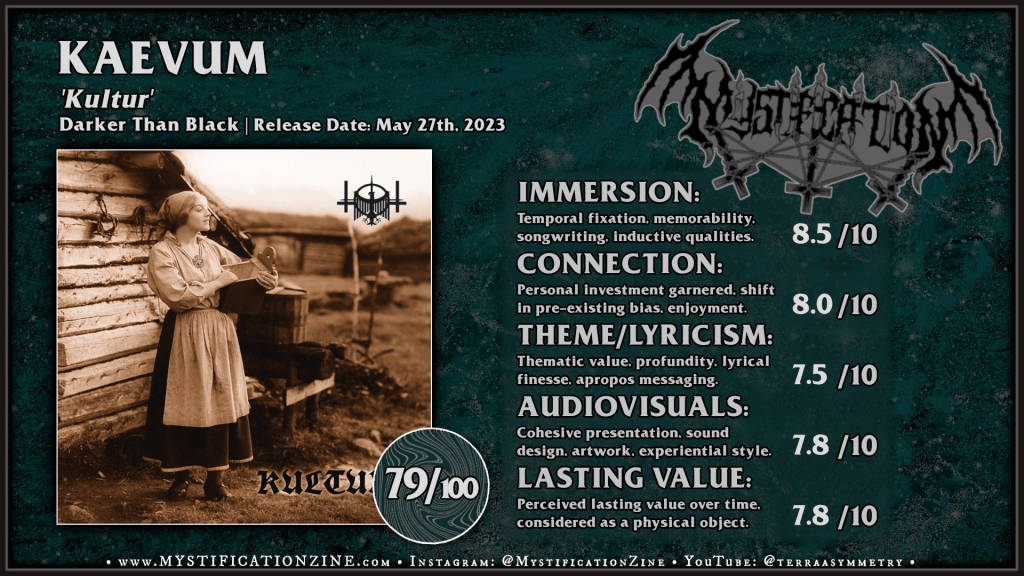
Kaevum is a Tromsø, Norway-based black metal quintet which features several members of Nordvrede and of course this includes some manner of either nationalist or white supremacist “edge” to their presentation. This is one of those groups that many seem to endlessly rant and rave about though I’d only found the first few songs on their 2011 debut all that substantial, or, I prefer when they were most afflicted and not so focused on their droning aspect. With ‘Kultur‘ I would suggest their affliction is at its most outrageous and frankly brilliant as this new vocalist Nordmann, who you might recall from Utbyrd back in 2017, is shocking in just how over the top and expressive his performance is. It might’ve become troublesome to have such a wilding vocal performance outshine the album but it’d never hurt say, Gorgoroth and such. Ultimately I’m left with the same issue as the first album as the running order turns to miserable droning, nothing offensive but the full listen hits a certain point of redundancy for my own taste beyond the fourth song.
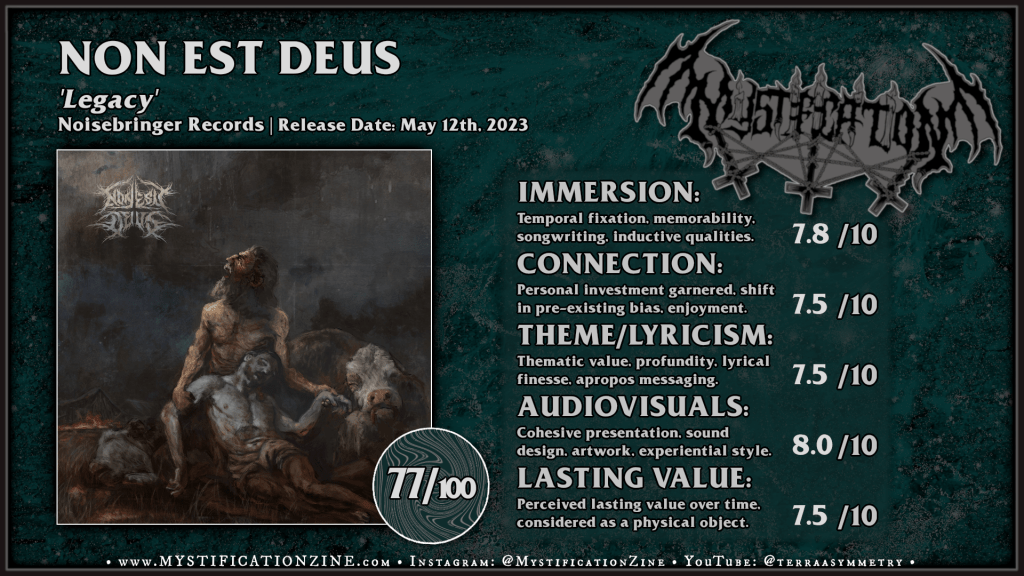
Non Est Deus is one of the longer standing projects from German musician Noise, the fellow behind Kanonenfieber and more recently Leiþa, and in this format his work is reasonably compared to gust and grind of Mgła at face value wherein the movement is immediately insistent, melodious and delivered with cold and determined diction. It is of course not a simple one-to-one comparison but the cadence of ‘Age of Excuse‘ does feel tributed on the first two songs which serve the core momentum of the first half. This could be said of many, many German melodic black metal albums of the last several years and I suppose that is the harshest I could get with this record, it does feel a bit typical even if up to a very high professional standard of composition and render. That said, by sheer attrition and repetition the character of this album does generally work as a full listen even if you’ve likely gotten the gist of its endlessly trampling and melodious declarations within moments. I’d especially enjoyed the “Redemption” pieces and their lead into “Thousand Years of Sand” as the hot spot on the record in terms of my interest.
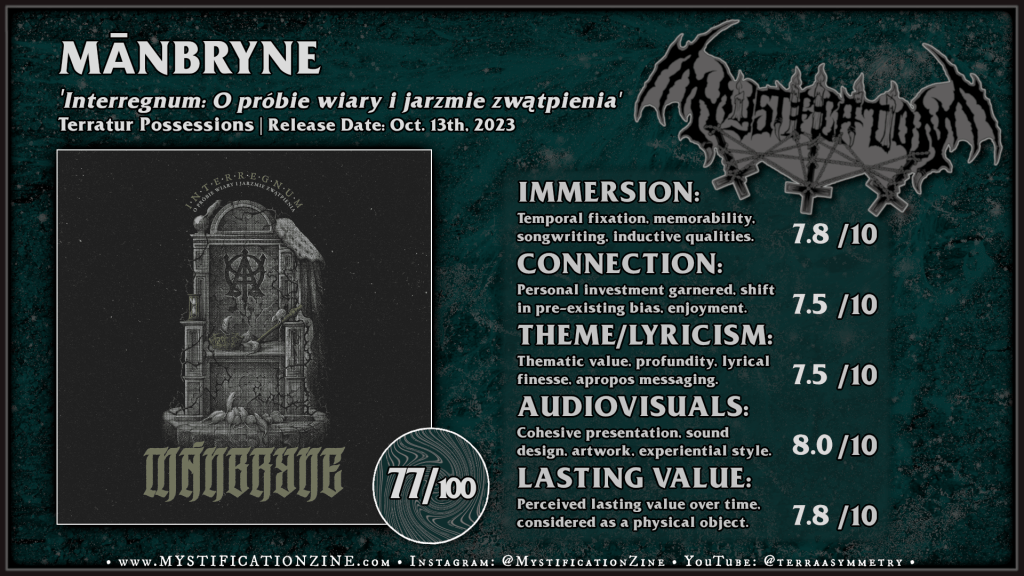
Lublin, Poland-based quartet Mānbryne are not entirely an offshoot of Blaze of Perdition, much of the writing comes from the unassociated guitarist Renz, but it does feel like a lot of the firmament they’d conjured in that other band has instead been implanted into this project as their better known form focuses on something far more accessible. That isn’t to say that their work on ‘Interregnum: O próbie wiary i jarzmie zwątpienia‘ isn’t melodious and easily approached, this isn’t such a fearsome work so much as a surreal experience prone to drone on it is rambling Mgła-esque voicing for ~7-8 minutes at a time, declaring its way flatly through each blasting hymnal. For my own taste the main draw here compared to the first album is the drumming as it’d consistently served the most interest across each full listen. “Grzechy ojców” is the most potent peak of the experience in terms of venomous energy and probably the best place to get an overall impression beyond the droning introductions.
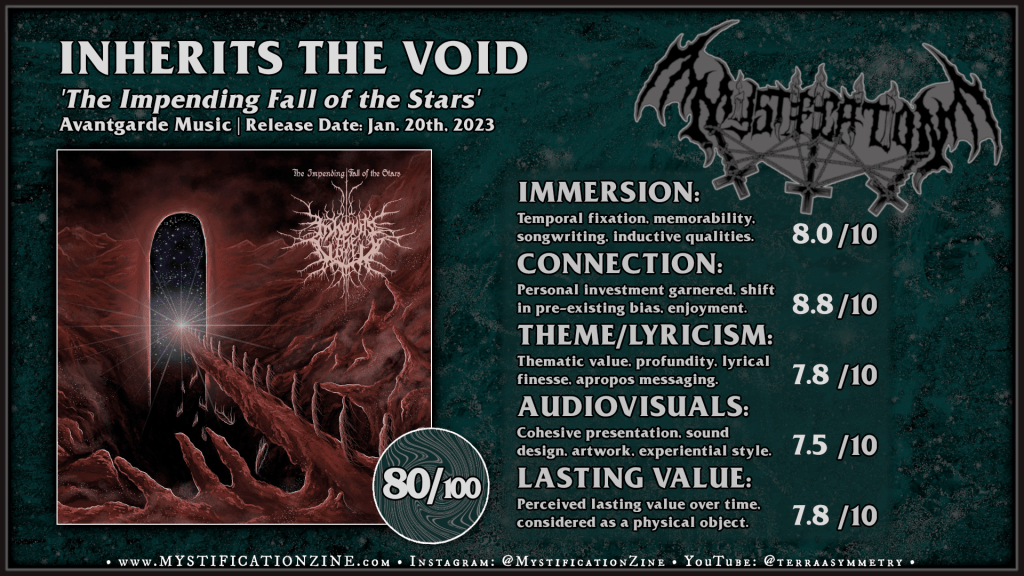
Though I was familiar with the previous LP from this southeast/central France-based melodic black metal project I didn’t recall it being so brazenly Dissection-esque (or, early 90’s melodic black/death metal) in style compared to this inspired second full-length. Rush right to “Sullen Laments of the Wanderers” to see what I mean. Inherits the Void is the work of one Antoine Scholtès and the fellow has completely floored me with this record in terms of a loud, wrathful and riff-forward rush of classic melodic black metal delivered with plenty of bombast and aggressive speed. The holistic effect of this record is cold and biting, not lush or dreamlike so many post-‘With Hearts Toward None‘ formed acts looking to the past for precedence, though there is a bit of an atmospheric black metal glisten to the opener/title track which lends a modern feeling to the first impression. I was surprised this was not marketed directly to me as this is exactly what I am always looking for month after month. A sublime gem of a record with plenty of depth and an effective enough atmospheric drift to its more static moments.
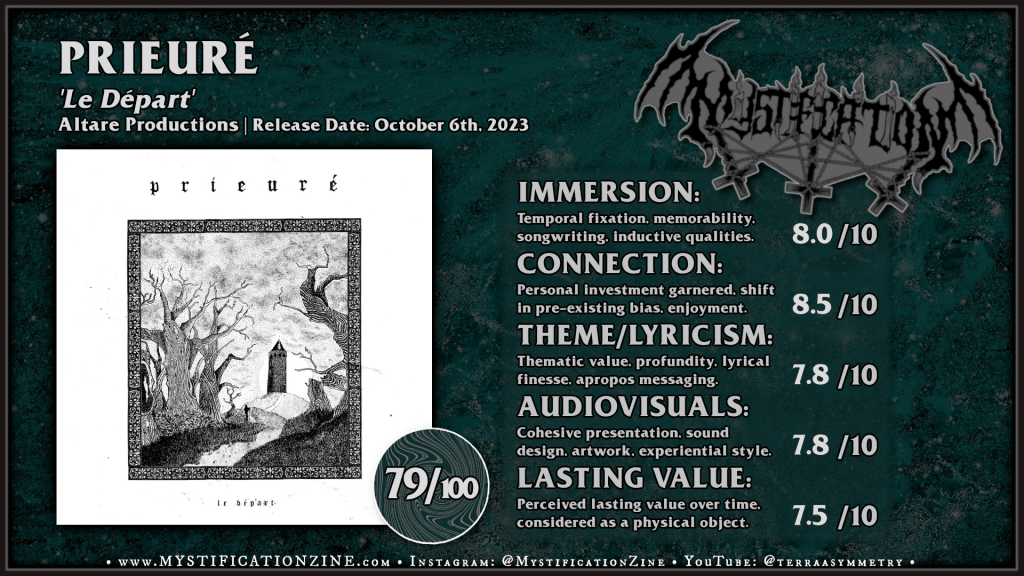
Prieuré is a brilliant black metal project from French musician Sans-Visage and ‘Le départ‘ is the culmination of several years work having developed a unique enough style and tentative resonance spanning several split releases and EPs, first catching my attention per their split with Vermineaux earlier this year. The mood here verges on coldly dismissive to start, almost to the point of a post-punk (no, not gothic rock) which works well with the variously striding and struggling movement of these fairly long pieces. The attitude remains jaded enough but we find piques of passion and sentiment sparkling throughout the involved nature of these melodious works. There is some earnest quality to the tirades included here and this is effective from the strike of the first few songs, taking me along for the ride which I’d found best illustrated in “L’homélie du crapaud” but don’t pass by without sitting through the vital title track/opener.

Spectral Whisper was the previous avatar of German black metal band Mysteria Mystica Aeterna when the project was solely lead by Noxathra (Lunar Chalice, Nightwalker). Although they’d changed their band name back in 2020 and have since released two full-lengths they’ve now released two additional albums (this being the second released, but first recorded) from their archives under their old name. Confused? Doesn’t matter, as this cold and ancient form of atmospheric black metal is not at all confusing in its showing of wrathful underground tunneling. I’d particularly enjoyed the cavernous gut-level vocals and the early 90’s grooves of the guitar work, taking me back to when I’d discovered Ancient‘s ‘Svartalvheim‘ and the second Darkthrone record. It isn’t the most deep and compelling release of course but an interesting relic from their development.
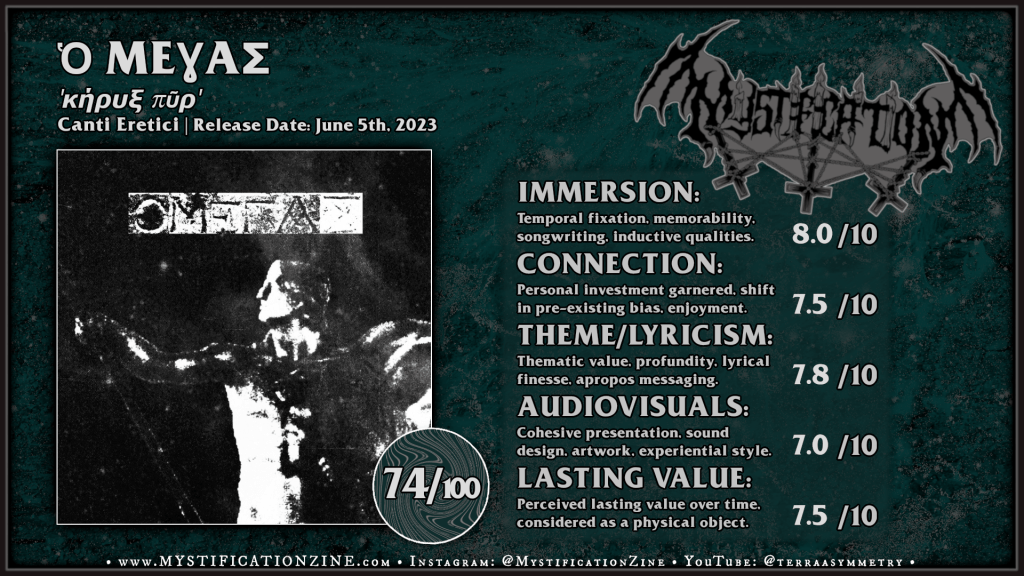
Though some might fear we are beginning to veer too far into the realm of Bandcamp‘s suspect noise and aped-art trash hole this first demo/EP from ὁ Μέɣας offers an interesting enough juxtaposition between very plainly meandering black metal riffs, three-piece drumkit “raw black metal” beats, and various bits of instrumentation which accentuate the Greek theme. I’m not sure that ‘κήρυξ πῦρ’ comes from Hellas, probably not, but the use of various middle eastern and Mediterranean instruments (which are mostly emulated via plug-ins etc.) make for a glitched yet compelling enough work. I’m not sure if I would classify this as sophisticated work or abysmal noise and I enjoyed the uneasy reaction I’d had to it since there is ultimately something musically viable layered beneath the amateurish collision of it all.

Active as a solo artist in the Spanish black metal realm since the late 90’s musician Ebola‘s efforts in Cryfemal were singular and entirely his own vision in blood until 2020 where he’d brought in drummer Guayota who has been at the kit for his other band Muert since the early 2010’s. This’d changed the dynamic of his craft in the sense that now much more was possible in terms of rhythms and a certain jagged sense of harmony and aggression leaked into this record and the previous one. All of this is good as it creates a cavernous black/death adjacent sound and a complete maniac showing where gotten an over the top, wild vocal from Ebola. On this album he feels like a tyrant leader, the necro-orator for this event and to me this recalls the feeling of very late 90’s black metal. My only complaint is the bonking, very downtuned guitar sound which sludges up the heavier hits of the album toward a modern touch here and there (see: “Mal Inmortal”) and this doesn’t always work for me even if the guitar grooves are not at all offensive. Before making a true judgement on this one I’ll have to go back and listen to more of their discography.

This third full-length album from Copenhagen, Denmark-based black metal duo Gabestok retains the garage punk inflicted ruptures of their past work yet there is a disaffected, somber side to several of the pieces here which make for an album which is darkly psychedelic, frustrated and ranting more often than not. I am always looking for crossovers between dreary punk nihil and black metal and this’d been one of the only true suitors to that style even if this record isn’t as tuneful (excepting maybe wailer “Det du smager af”) as some of their past work overall. The moodiness of ‘Med freden kommer hadet‘ was the main reason I’d returned to it repeatedly since release and wanted to make sure I’d gotten a chance to recommend it here.
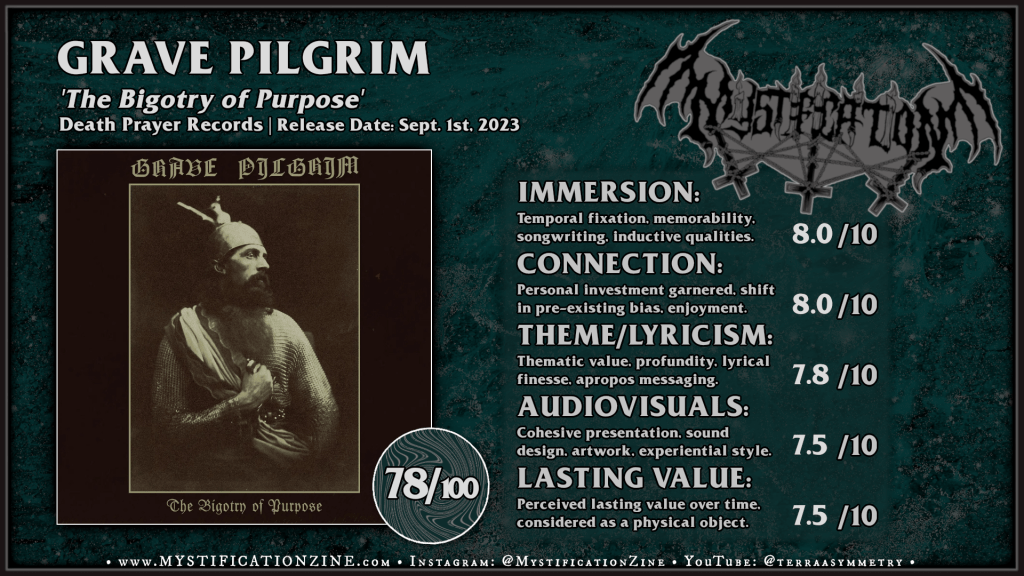
Raw melodic Oregonian black metal duo Grave Pilgrim return for a second LP of what they’ve described as Americana inspired black metal, though I’d just as well figure their clear nods taken from Grand Belial’s Key, Fin, and Peste Noire are more obviate. In fact the riffcraft here is humbly recorded but brimming with heavy metal spiritus and elaborate folken melodicism to the point that the whole of the album captivates from start to finish for my own taste, taking fewer detours compared to their first album and the somewhat under-discussed ‘Molten Hands Reach West‘. Though every piece here has some intrinsic value it was “Sublime Flagellation” which’d resonated most with me and gave the best sense of space inhabited, very much a rehearsal room level recording with its unsteady verve to keep things edging upon the ear.

Returning over ten years beyond their first full-length album Sydney, Australia-based melodic black metal project Sorathian Dawn create a satisfying enough rush of noisome aggression on this decidedly modern and ‘epic’ atmospheric variant upon a classics inspired sound. While many might point to the Swedish scene of the mid-90’s for reference that’d be a few generations removed, this is more of the modern German black metal iteration upon that sound where post-black metal and atmospheric black metal replace direct melodic riffcraft in complex throng. Though the production is a bit blown out and the aggression of ‘Radiant Terror‘ doesn’t always deliver much of the album feels eventful and dramatic. Despite finding this album a bit too vanilla, a standard impression of melodic black metal, it’d been an entertaining enough listen and worth mentioning to folks who must have every potential variant at their disposal.

<strong>Help Support Grizzly Butts’ goals with a donation:</strong>
Please consider donating directly to site costs and project funding using PayPal.
$1.00
Make a one-time donation
Make a monthly donation
Make a yearly donation
Choose an amount
Or enter a custom amount
Your contribution is appreciated.
Your contribution is appreciated.
Your contribution is appreciated.
DonateDonate monthlyDonate yearly mystificationzine.com