
You awaken in some sort of train car, seated in an operating chair surrounded by all manner of implements and sure, you’re an androgynous youth with a porcelain appearance and yes, there is an ethereal female voice right out of a budget anime voiceover experience beckoning you awake but no, this isn’t anime Pinocchio-souls right out the gates. As much as the first impression of Lies of P feels like a cheap and quick shove into its half-immersive and half-directed style of storytelling it certainly does well to explain itself briskly before handing the player a choice of three weapon types/classes and shoving them out of the door into a ruined train station with a couple of shambling and sparking robots about fifty meters in the distance. From the moment you’ve taken control, whipped your weapon around a bit and learned to lock on, dash/roll, and such the seasons soulslike enjoyer will feel immediately at home within this third person action RPG format where movement is tautly controlled, animations are fluid, and methodical aggression alongside well-timed defensive measures bears the best rewards in combat. For folks who just don’t give a shit about how original a goddamned video game -should- be the appeal of this user experience is immediate and probably intense, it feels a lot like Round8 Studios/Neowiz Games have weighed the controls and animations to those of Bloodborne (2014) and skinned the experience to invoke a mysterious but also strangely fantastical setting. For most folks this is enough to send ’em digging into this game and in truth, you’ll find exactly what you’re looking for in some basic sense, an above-average game in this niche which plays and runs particularly well. There really isn’t any barrier to this ride and I have to commend the developers for creating the proper tunnel vision needed to immerse right into thier creation, derivative or not.
Every year since 2011 or so smaller developers have taken to attempting to re-create or plainly copy the Dark Souls experience: Difficult yet weighted third person combat, metroidvania-esque exploration, hands-off narration and plenty of rich ambient storytelling within a distinct dark fantasy world. I get the appeal and I am certainly part of that demographic who will try anything in this action RPG (or quasi-RPG) style though it has never been a guarantee in terms of quality even when under the hallowed From Software umbrella. I’ve been burned by some real student project level trash (Immortal Unchained, Mortal Shell, Hellpoint, Thymesia to name just a few…) in this vein over the years and a few games which were obviously doing their best to design something functional in that space such as Code Vein (2019) or last year’s Steelrising (2022) and the most common faults are predictable. The biggest failures in this space come from lackluster/generic world-building, ineffective or unbalanced combat mechanics, and worst of all lack of distinct level/area design which justifies the mechanics of the game. This’ll be a much bigger point of conversation surrounding the horrendous Lords of the Fallen (2023) but eh, we’ll get there when we get there. The Lies of P experience stands out quite naturally in this space not only for its uniquely stylized world but the level of polish the game has received in terms of its physics generally making sense, the combat in particular has a nice amount of weight to its hits on both ends, and the whole of its design reading as cohesive throughout the the experience.

What is so special about this weird-ass soulslike game? Why on Earth would anyone make a third person action game based on a “dark” version of Pinocchio? These are important questions to ask and there are two reasonable ways to answer them: The first is, well, playing the game should elucidate why a dark twist upon a story of self-actualization through benevolence is necessary. My guess is that the familiarity and specificity of the Italian folk tale/novel naturally helps frame the story with themes of authenticity and integrity at the heart of its foil though the Eldritch twist upon the tale takes this whole sense of embracing the inner “good” of every person as a terrifying ambiguity, that trust and deception are choices which require a better read upon whomever you’re dealing with. The town of Krat may as well be Innsmouth and you’ll quickly see the line blurred between the humans who are using the alien alchemical source of energy (Ergo) for both good and bad and the “puppets”, which are essentially automatons capable of some manner of sentience per their infusion with Ergo. Are you a mercenary in service to crooked Geppetto? (Yes, get your laughs in now) Or are you a do-gooder with free will, out to free both people and puppets from the gnarled power-seeking craze of “the Alchemists”? You don’t have that much of a choice, really, and fair warning I am going to spoil the story of this game throughout.
What makes Lies of P special is that it sets a high bar for functionality, offers modest complexity within its systems, sets the skill level high in terms of challenge, and rewards per its gameplay experience. In the process of enable the player, providing an ideal gameplay experience doesn’t mean sacrificing any of that elegance to overly ambitious visuals, ensuring the user has a functional and finished product to become immersed in from the start. Even if the punishing side of some fights initially seem ridiculous and raw these choices eventually make sense in terms of how the developers insist the game is played, providing the feeling of mastery for those who are persistent enough to see it through. That said, for all of the praise I’d launch at this game at the outset I will have to warn folks that you’re going to have to be up for a brutal challenge with a few obnoxious difficulty spikes. These will feel outrageous if you’re a bit of a lazy, repetitious player who doesn’t explore their options or get clever with solutions. Wimps that rage and quit when their games get hairy probably shouldn’t jump in because this one is a bastard if you’re not willing to learn, adapt and improve. No need to “get good” necessarily but most definitely expect a ton of unfair bullshit to get whipped at you until you get smart with solutions.
Je vais bien… et comment tu va? — Setting the realm of puppets-gone-horror automatons a little bit too close to the underrated Steelrising might seem strange since the similarities are a bit too close as we find cities on fire and in the midst of havoc per robots that’d been designed to potentially do much more than help humans. The suggested Belle Epoque-era setting has absolutely nothing to do with the Italian characters in the original story and this is made a bit off-mark per some French chanson pieces featuring heavily in the soundtrack (collecting and listening to vinyl is a mechanic for developing human traits, even) but this should read as a generally “European” setting from South Korean developers. Of course this is a much bigger game with double the amount of areas which bear a similar design ethos which only briefly knot their tracks back to centralized shortcuts per designated semi-open world areas, you’re still essentially selecting levels per the fast travel mechanic. I could go into weapon types, move-sets and deeper details but for all of the the similarities shared between these games what Lies of P has over any comparison to Steelrising is superior controls, combat, and boss design plus a ~30-40 hour playthrough if you’re thorough and significantly less if you can somehow master its combat with heroic efficiency. I think this begins to steer us toward the main glowing point surrounding this game and its virtues.
The design of this game is both elegant and incomplete in its solutions to the zeitgeist’s most persistent issues. Where this suggestion holds up best is in the intentionality of the world design and how it applies to enemy up-scale (a la Sekiro) as you walk through these areas and work through them. In the first half of the game you’ll see the progression of the puppets going mad and the trail of destruction and death they wreak upon the city until a second type of infection (ergo corruption) begins to infect corpses and puppets alike, causing enemies to become more dangerous and unpredictable. Most but not all enemies make sense in their placement as the game builds its horror-scape in layers of dead puppets and massacred people. As things begin to unravel and (generally speaking) make less sense plot-wise in the more fantastical second half of the game this changes and certain areas feel either less lived-in or related to Krat, such as the brief push through the large crystal ergo shards that spike up in the earthquake stricken section of town after an unexplained explosion. Likewise a few bosses feel interruptive or poorly set as the antagonist of any particular zone, the Green Monster of the Swamp being required makes little sense in terms of the story beyond the junkyard setting and the Black Rabbit Brotherhood are only satisfying as a defeat under your cap for how annoying they are, they hardly earn their reputation apart from being opportunistic. The lore which explains these things are reasonable enough but at some point the enemy designs do become more generic and are used in strange combinations as the scope of the game drags on up the tower towards the end. Looking back on the setting and its experiential value to the story might seem questionable but in terms of gameplay the linear series of events is properly serial, cinematic in a comfortable way which only veers too far into unrelated fantasy a couple of times. It certainly isn’t Dark Souls II with its endless elevators to random locales.
Combat options are just as measured in the sense that weapons are either made available to purchase or are discoverable per the progress of the player’s exploration, naturally, and regardless of your approach no one option trumps them all. Yes, you will be at an advantage using Technique (Dexterity) scaling weapons overall, being faster is always better since you won’t hardly be a tank even with a proficient Motivity (Strength) build in mind per commonly trading hits with fast, multi-hit combos from most bosses. You’d think combining handles with different blades (blades are upgraded with materials, handles’ scaling can be changed with items) might be too much to keep track of and try out but this is one of the only options to personalize your play style even further, or swap at will depending what weapon effect or attack type you need for a challenging boss. Otherwise it might be fair to consider the Wishstone Cube specific skills an excessive option until you’ve realized it is primarily there to ease single player difficulty, distract bosses (via the summonable Spectre) and mitigate their habit of input reading and endless supply of stamina. There are also wishstones that regen health and whatnot but most folks will stubbornly avoid the cube until they’ve the guts to go for NewGame+ and realize that help is almost necessary to survive at all in certain cases; Where is the game “incomplete” in its design? The nuance of the combat is lacking in terms of “tells”, telegraphed attacks do not account for the third person perspective and make no notable audiovisual cue for incoming attacks beyond the unblockable ones which can be perfect parried, some of which -have- to be nailed in terms of timing to defeat the boss. Now that doesn’t mean the combat is broken per se but it does mean there are a few unfair points of design when we look at the boss fights and the unforgiving nature of the combat.


What are the most common complaints and will they apply to your experience? — In their attempt to make a smarter, almost too clever AI response to the usual string of attack and response Lies of P‘s combat designers fundamentally want to add to what Bloodborne accomplished by cutting away the sword-and-board option as their ideal initially focuses on quick dodging around attacks and perfect parries being the only way to mitigate incoming unblockable attacks. This means adding chip damage to blocks despite shield alternatives (literally just your left arm) bearing their own parry mechanics and since trading damage is almost never in your favor, plus stamina is seeming unlimited for enemy combos, the difficulty of each boss will ramp quickly over the course of the game things quickly unless you begin to learn to time parries. What Lies of P is ultimately missing is any sort of reward for mastering its parry timing beyond Stagger/Break damage. On one hand this does make combat feel more visceral, unpredictable and difficult but on the other hand learning each enemy’s attack patterns and timing feels like trash and this doesn’t improve until you’ve parsed which enemy type animation s are carried between level fodder, mini-bosses, and bosses. The failures of Wo Long: Fallen Dynasty are echoed here in a lighter way, where unblockable attacks act as skill checks and unpredictably delayed timing of attacks (see: Elden Ring) paired with input reads act to engage a player who has likely mastered the last ten years of this type of game.

At the mid-point in the main storyline there was no reasonable alternative to simply getting better, improving my build. — Take it from a guy who’d uninstalled and wrote a negative review on the Windows Store after I couldn’t beat the Puppet King boss’ second form, yes, it may feel like no real consistency exists between enemy timing, combo patternation, and predictability is low but these are not insurmountable. At some point I’d had to give credit for the AI jamming unpredictive attacks, hitting their randomly generated skill set with a semblance of intelligence rather than easily baited reactions. The machinery you are fighting is barbaric, reactive to some degree but also ruthlessly violent to the point that Lies of P‘s gameplay requires the player to consider its moment-to-moment action its own creation. I came back the next day, gave it a few more tries, switched to a faster weapon (upgraded it) and figured out how to make it work. What is the alternative? Think you can grind out weapon upgrades? Gated by progress. Think you can use the cube? Gated by in-game timed currency. Think you can grind out levels? Get ready to spend hours scouring each area for low-density quick to kill enemies, there aren’t a ton in the first half of the game. You certainly have options but at some point the choices you made might’ve been stupid and you’ve no chance but to resourcefully find a way to gain the advantage in terms of skill or speed, ideally both.
Tips that’d solved the problems hindering boss combat in my playthrough. What Lies of P lacks in accessibility per its obsessive difficulty is at least made up for in terms of spectacle and, again, there are a few options to work around skill issues I’d had with my Technique focused build: [1] Breaking “poise” is key to taking bosses down and there are three ways to do this, the first is obvious enough in terms of parrying all attacks from the enemy (building up Break damage), the second comes via using status effects which target stamina (such as Shock/Electricity) and finally charged R2 (Heavy) attacks usually stagger most bosses in anywhere from ~3-5 hits with that number rising later on and this allows for Fatal attacks which are you main damage source. [2] Use the Wishstone cube and the Specter summons, these offer a distraction at worst and a damage sponge at best and you have to earn Gold Coin Fruit (which generates over time) to buy more wishstones. [3] Directionality of attacks is consistent, simply dodging left can be all it takes to sidestep all of a bosses attacks. [4] If you aren’t using your Fable attacks you are wasting time as building up your Fable meter + building up Stagger (for Fatal attacks) are to two most consistent ways to beat any boss. [5] All of these can be spec’d for per the P-Organ skill bonus system where Quartz items are slotted into tiers of modifiers which can help raise Stagger damage, resist knockdown, gain more EXP, gain more Fable gauge, etc. More broadly speaking:
- Weapon customization is deep in combination and more-or-less encourages experimentation early on but save limited resources (such as upgrade materials) until you’ve decided which weapons are effective for your play style.
- Staggering is a matter of hitting charged attacks quickly during enemy openings. Fatal Attacks are a huge part of killing bosses, but charged attacks aren’t the only way to Stagger an enemy. You can conceivably learn the parry/block timing and spec to Stagger upon perfect block.
- The comfort zone of dodging through and around attacks isn’t going to feel great unless you use the P-Organ specs to dodge while knocked down and to “double-dodge” again mid-dodge. Most enemies are right or left “handed” in some sense.
- When you’re leveling up your P-Organ choose options which directly enhance your style of gameplay.
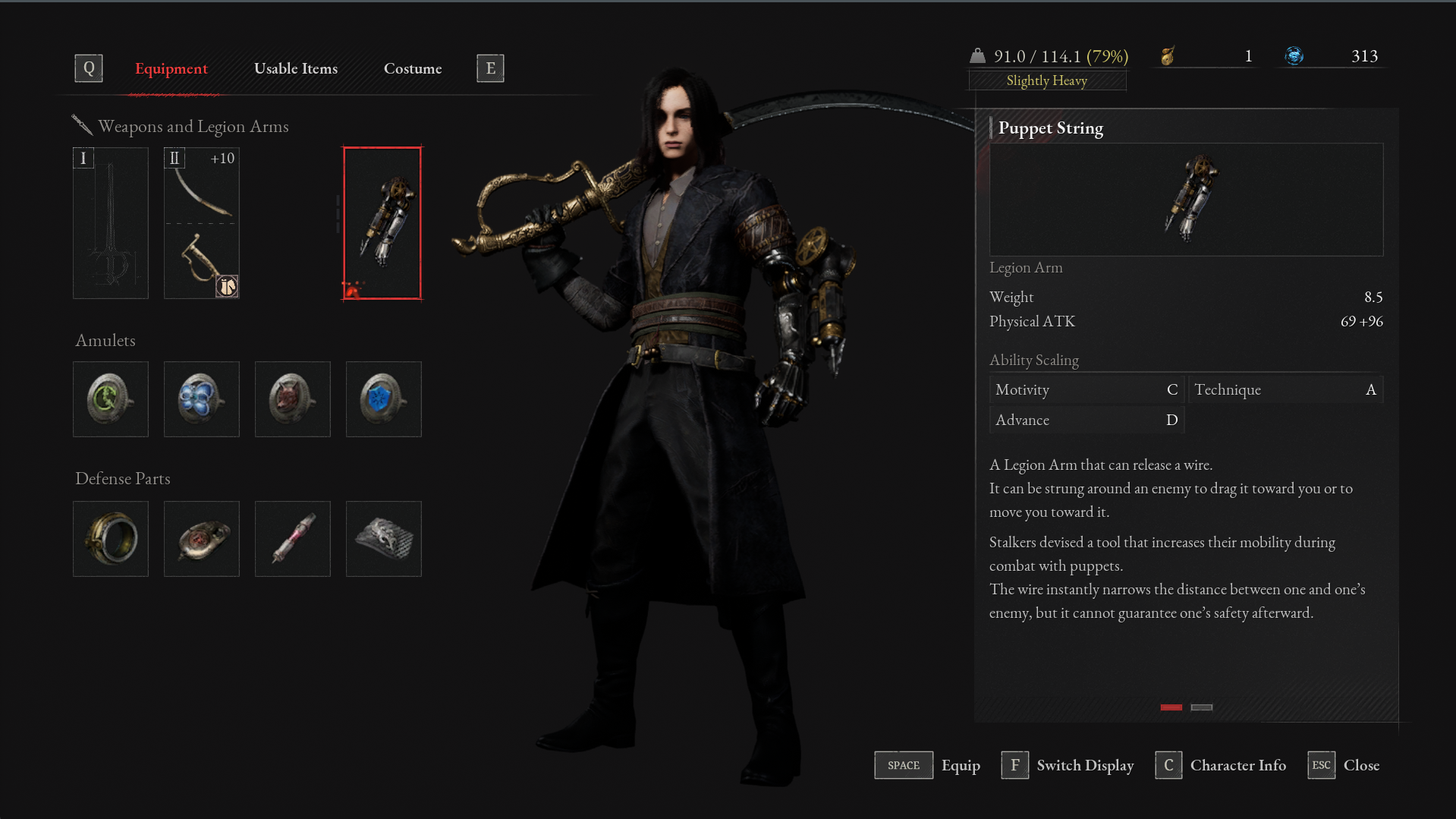
- Do not overlook the Stagger potential of the Legion Arm attachments, much less the mobility and status effects offered by different ones. Keep in mind Legion Arm upgrade materials are very limited, you might fully upgrade two arms if you fight every optional boss/do everyside-quest.
The story which Lies of P tells reveals itself with plenty of tact but it ain’t that deep. When it becomes time to reveal the actual lore with the less-than charismatic voice cast handling the reveal it all lands horribly flat. Gemini, the cricket guide inside your butt-lantern acts as a narrator for tips and explanation of setting to start before attempting some light comic relief at the wrong time and this as a whole could’ve been cut as the one-sided dialogue feels like a bad attempt to make sure the dumber spectrum of the audience knows how they should feel after folks die. The story truly begins to drag after you’ve completed the Junkyard section as the game looks for a way to break into its second act and instead gets weird as city cracks open and spews a bunch of Ergo crystals. Once I was off to save Geppetto and the home base was vandalized the charm of the game began to wane since the impact of exploration is less consequential once you’ve reached the Alchemist island section. That final area, which coincides with a host of loose ends to tie up (the Trinity Sanctums, side-quests, etc.) is far too large and mazelike without the ancient civilization elements making any real sense in context of the tower. This area is hose to some of the hardest boss fights of the game but this won’t be as intimidating as the density of enemies who continue to focus on cheap kills per status effects like disruption.



In the end the player must ultimately make a choice to either selflessly grant Geppetto‘s dead son (Carlo) your heart so he may live or to keep the will to live and fight a construct (a final boss puppet). Under various scenarios Geppetto might die, your puppet friend (the Blue Fairy in the original) Julia might live, and just like any From Software-alike game there are a few potential endings to attempt. I hadn’t looked anything up and dumbly handed over my heart without getting to try the (true) final boss. Yes, your father was evil all along and once he takes your free will (heart) he has you kill the entire remaining cast and y’all just walk away. The post-credits ending contains the suggestion that the sequel will feature Dorothy from The Wizard of Oz as these alchemists find “brothers” within enchanted lands. For me the revelation of Paracelsus as the true identity of one of the characters is a bit of a stretch and the promise of another “dark fable” game doesn’t necessarily impress with the bad Playstation 2-era CG video of Dorothy tapping her red heels while facing Hotel Krat. I had to laugh and I’m sure plenty of folks did the same. The journey is far more interesting than the endpoint.
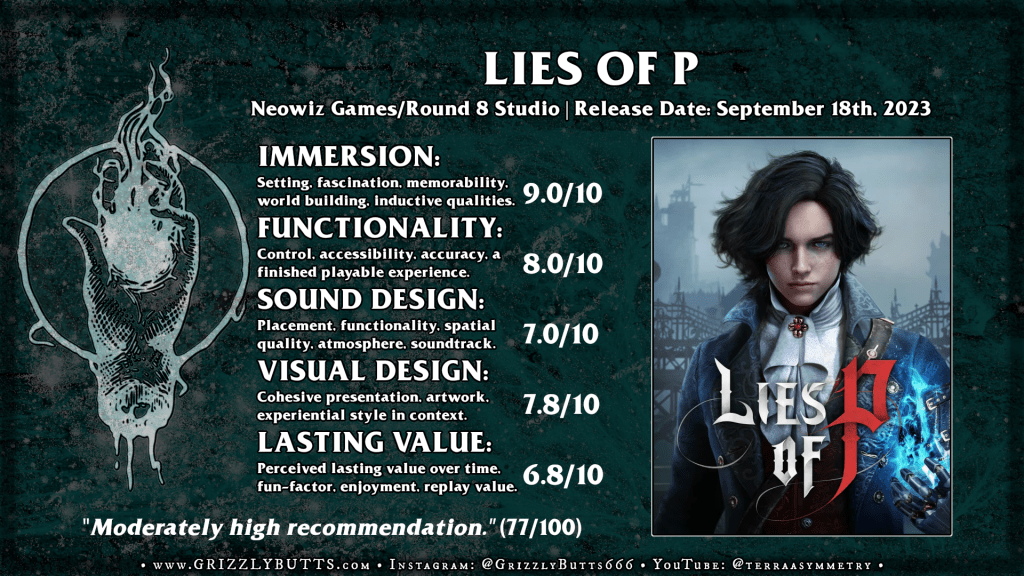
Though it doesn't always earn its difficulty through clever design [Lies of P] allows the player to remain adaptive enough to survive its skull-bashing machinery. A slick, nigh essential soulslike.

https://www.liesofp.com/en-us/

Help Support Grizzly Butts’ goals with a donation:
Please consider donating directly to site costs and project funding using PayPal.
$1.00
Make a one-time donation
Make a monthly donation
Make a yearly donation
Choose an amount
Or enter a custom amount
Your contribution is appreciated.
Your contribution is appreciated.
Your contribution is appreciated.
DonateDonate monthlyDonate yearly mystificationzine.com